Content note: Historical involuntary movement, family distress and disputed reports of death; no graphic descriptions.
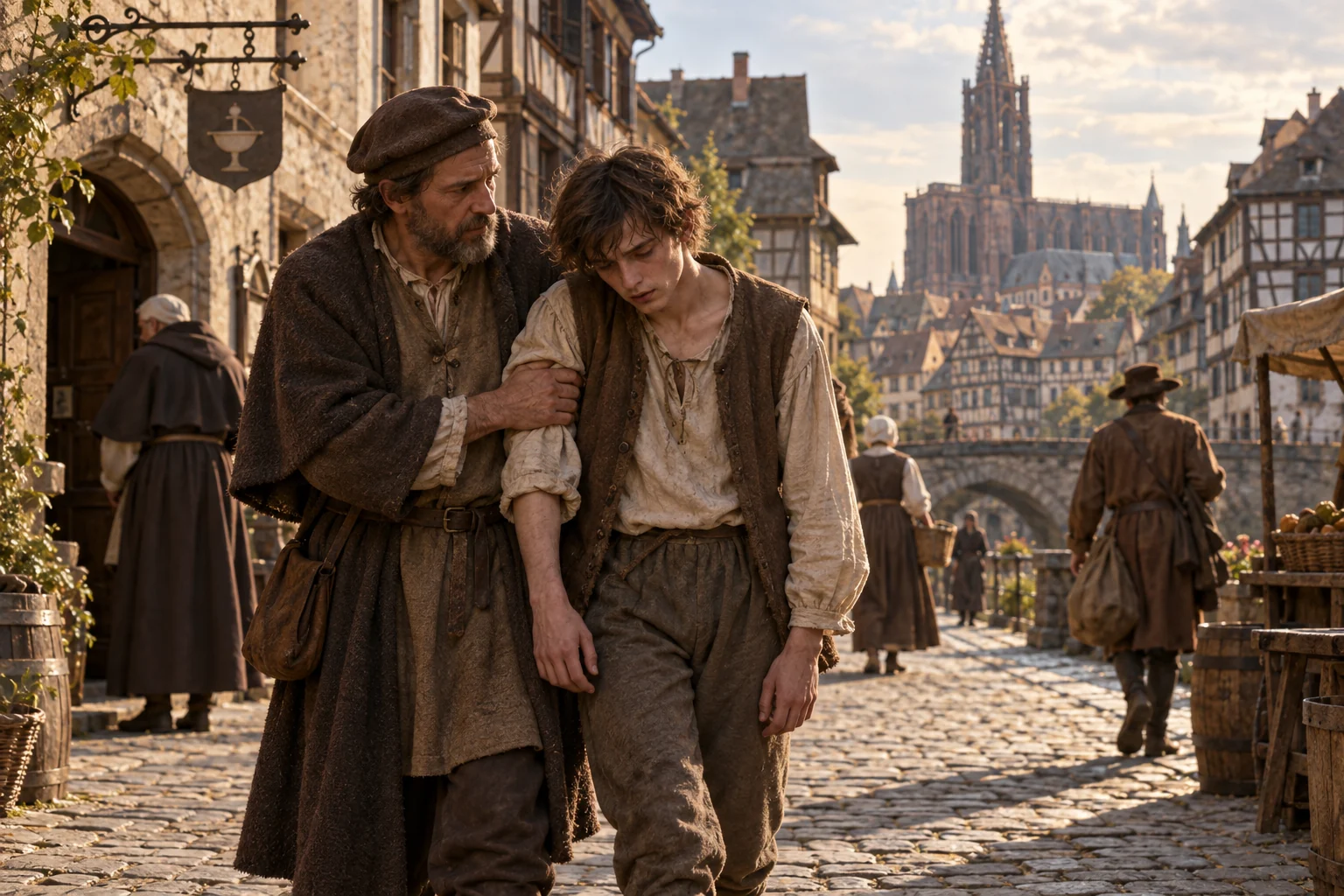
On July 23, 1518, a servant named Staden Jerg had a problem that would not fit inside his home. His son was among the people dancing in Strasbourg. Summoned before the city's representatives, the father said he could not keep his son there. He asked that his son be cared for with the others, or taken to the saint whose shrine offered a possibility of relief.
A relative had already collected money for his son. The carpenters' guild was holding it. The municipal record preserves these small, practical details beside the extraordinary affliction: a father, a son, a collection, a household unable to manage. It gives us no account of what the son felt while he moved.
That summer, people in Strasbourg were dancing in ways their neighbors and authorities understood as illness. The familiar activity had become a public emergency. For Jerg, the emergency had a family member's place in it. Someone needed to look after his son, and he was telling the city he could not do it alone.
A woman, then others
Two days later, the city's government described the beginning in a letter to Bishop Wilhelm: a woman had started, and others had followed. The physicians consulted by the authorities considered the condition a natural illness, connected with the current heat and an alignment of the stars. Those affected had been watched over and taken to Saint Vitus, also called Saint Guy.
Here the strangeness is close enough to touch. Dance ordinarily suggests an occasion, companions, a beginning and an end. The reports describe an activity that had escaped those boundaries. A movement associated with pleasure now required supervision, money and decisions about where a person could be kept.
The woman in the letter has no name. Nor does Jerg's son. Their anonymity leaves the human predicament intact: people had become ill, families were involved, and the city had to respond. We do not need to give the woman a face or the son a speech to recognize how much ordinary life depended on being able to stop.
Sources [1]
Who could keep a dancer?
The July 23 deliberations placed responsibility on citizens whose children were dancing. They were to care for them at home or contribute toward the expense. Jerg described himself as poor. His request exposes the gap between an order to provide care and a household's ability to provide it.
There is no need to invent an argument in front of the officials. The recorded exchange already has its conflict. The city wanted families to take responsibility. A father answered with the limit of his resources. Between those positions stood his son, whose needs could not be resolved by deciding who ought to meet them.
This is the epidemic at the scale of a household. The grander images of Strasbourg can make the dancers seem like one moving crowd. The administrative detail breaks that crowd apart into relationships. People belonged to families and trades. They needed somewhere to go. Their care had a cost even when the cause of their condition remained unclear.
The city's archives still hold the traces of questioning relatives, involving guilds and arranging journeys to Saverne. These were efforts to manage a crisis through the institutions available. They also gave those institutions power over where the affected people stayed and what would happen to them.
The unsettling medicine of music
The physicians' advice included food and drink: barley preparations, bread or porridge, and no wine. It also included music. But the recommendation distinguished between instruments, allowing strings or a small organ while excluding drums and fifes.
That distinction matters. A drum beating beside a collapsing crowd makes an irresistible scene. The surviving advice points toward something more particular: an attempt to select the right sound for people already afflicted. Music could belong to treatment as well as entertainment. The same act could be understood as a symptom, a remedy or a danger, depending on how it was arranged.
Historian Lynneth J. Miller places such responses within medical theories in which bodily heat and the condition of the blood could explain excessive movement. Under some versions of those theories, further movement might help restore balance. This was an explanation available to the period, rather than a demonstrated mechanism of the Strasbourg outbreak.
The resulting predicament is disturbing without embellishment. A person whose dancing worried the community might encounter music offered in the hope of relief. Once a theory had made movement therapeutic, stopping and continuing no longer had their obvious meanings. Care depended on an interpretation of the very behavior everyone was trying to understand.
The saint was already in the story
Saint Vitus is often presented as the city's last resort, after a spectacular attempt to dance the illness away. The July documents complicate that sequence. Sending affected people to the saint was already part of the response when Jerg made his request. Medical consultation and religious recourse overlapped.
For the people arranging those journeys, a shrine could be a destination for healing. For a family unable to care for someone at home, it could also offer a course of action. We cannot recover what Jerg believed would happen there. His request shows that the possibility was available to him.
In early August, a prohibition on public dancing was issued in the city's name, signed by its secretary, the humanist Sebastian Brant. The intervention tried to place a boundary around the activity. A city could prohibit public dance even while it struggled to explain the people already caught in it.
The episode subsided over roughly two months, according to the Strasbourg museum's account. That ending does not identify a single successful treatment. The records do not follow Jerg's son through a documented recovery, and we should not manufacture a homecoming for him. What survives is the father's request and the measures taken around people like his son.
How the crowd became more terrible
Later accounts make the episode larger and more theatrical. Writing around 1580, Daniel Specklin described prepared dancing spaces in the markets, paid companions and musicians. He also described deaths and red shoes used in a healing ritual. The museum's source dossier places that account on a separate page from the contemporary municipal documents.
The separation changes what we can confidently picture. Specklin was writing decades afterward. His narrative is evidence of how the event was remembered and transmitted; its dramatic particulars cannot simply become a minute-by-minute eyewitness report. This article therefore gives no daily death toll and treats neither the red shoes nor the massed market dancers as a securely reconstructed scene.
Even the best-known name belongs to this problem. The woman commonly called Frau Troffea is unnamed in the contemporary letter. The museum's historians identify the later name with Paracelsus, whose account appeared after his death and whose Strasbourg stay came years after 1518. His story does not supply a verified biography of the woman who began dancing.
A name makes it easier to attach a face to the outbreak. An exact death toll makes the danger easy to measure. But the unnamed woman and the uncounted consequences remain unsettling. The absence of those certainties brings us closer to the bewilderment that made the city write letters, question families and organize care.
What can be answered
The cause remains unsettled. Proposed explanations have included poisoning by ergot, a fungus associated with grain, and psychological or social processes shaped by distress and belief. The Strasbourg museum explicitly challenges the confidence of some modern retellings. A theory about the outbreak is not an examination of any one dancer, and the surviving documents cannot establish a modern diagnosis.
There is a more concrete question we can answer. What did the dancing do to the community around an affected person? It brought private care before public authorities. It made family resources, collective responsibility, medical advice and religious healing part of the same urgent problem.
Return to Jerg's request. The source does not let us watch his son dance. It lets us hear, through an official record, that a father could not manage his care at home. That is a different kind of closeness: the moment when an extraordinary historical event becomes a need someone must meet.
The dancing eventually passed out of Strasbourg's streets. The demand in that document is still recognizable. Someone is ill. A household has reached its limit. An explanation may take years, or never arrive. Care cannot wait for the mystery to be solved.
More stories from Memento Medica
For more interesting content, follow Memento Medica on YouTube.
Follow Memento MedicaWritten and illustrated with AI assistance for Memento Medica. The lead image is an interpretive illustration, not historical evidence. Factual claims were checked against the references listed below.
Sources & what we can know
An original narrative based on independently checked sources. Contemporary municipal records are consulted through the Strasbourg museum's French translations, not the original manuscripts. Later chronicles, Paracelsus and modern theories are identified separately. The first woman's name, exact scale, mortality, medical cause and individual outcomes remain uncertain. No dialogue, private thoughts or matching film have been invented.
- Musées de la Ville de Strasbourg: 1518, la fièvre de la danse — teacher dossier (2018), pp. 11–12
Full 19-page dossier downloaded; relevant source-critical sections and pp. 11–12 read, with p. 11 visually inspected on October 15, 2026. Uses its French translations of July 23 municipal deliberations (AMS III 200/15), July 25 council–bishop correspondence and medical advice (ADBR 12J 1495). Specklin ca. 1580 is explicitly later. Original manuscripts were not directly examined. English paraphrases are editorial translations.
- Archives de Strasbourg: institutional account of surviving 1518 records
Full public archive-authored post read October 15, 2026. Identifies 1 MR 3 and III 200/15, questioning of relatives, journeys to Saverne, guild participation and August 2 prohibition signed by Brant. This is an institutional summary, not a manuscript facsimile.
- Lynneth J. Miller: Divine Punishment or Disease? Medieval and Early Modern Approaches to the 1518 Strasbourg Dancing Plague (Dance Research 35.2, 2017), pp. 149–164
Publisher-indexed full text and sections read via search retrieval October 15, 2026; direct publisher opening returned 403. Used for period medical theories and source transmission, not its confident opening death counts, Troffea identity, or linear medical-to-religious cure chronology. Those are held against the museum's later primary-document critique.
- Musées de la Ville de Strasbourg: 1518, la fièvre de la danse — exhibition press dossier (2018), especially pp. 3–5, 7 and 9
Museum-authored dossier read October 15, 2026 through a public institutional-document mirror. Introductory/source-critical sections, manuscript checklist and catalogue excerpts read. Supports roughly two-month duration, critiques later embellishment and Troffea naming, and distinguishes hypotheses. Archive originals and complete paid catalogue not independently inspected.