Content note: Historical surgery, pain, and incomplete anesthesia; no graphic descriptions.
Edward Gilbert Abbott was twenty-one when he became the patient in one of medicine’s most celebrated demonstrations. He came to Massachusetts General Hospital with a swelling near his jaw that had been there since birth. History would remember the anesthetic. His record would preserve a different outcome: the swelling was still there when he left.
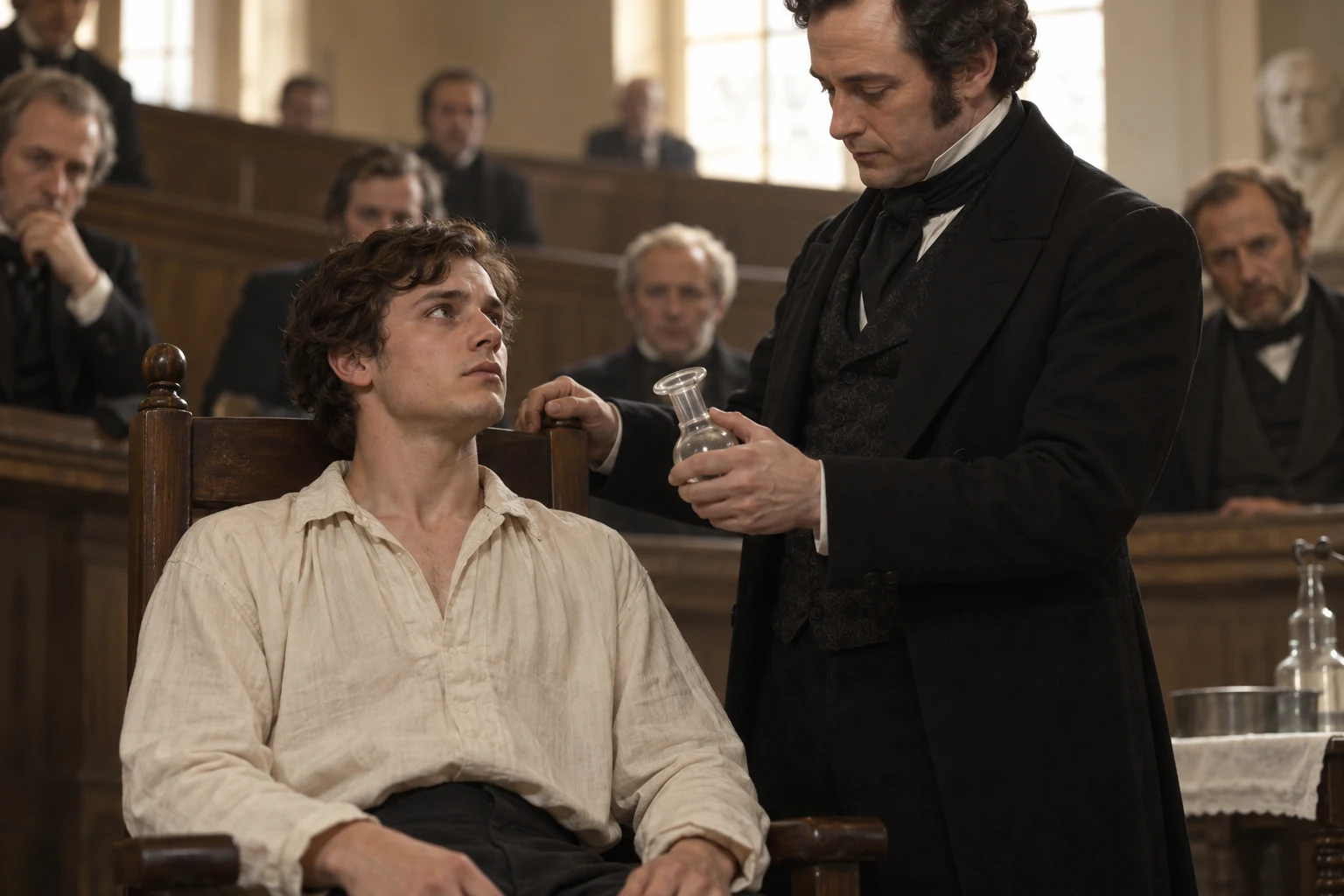
On October 16, 1846, dentist William Thomas Green Morton administered ether while surgeon John Collins Warren operated. The public Boston demonstration became a defining moment in the spread of surgical anesthesia. It also left conflicting accounts of how completely Abbott escaped pain.
One early published report described considerable pain, although reduced. A later account placed in the record book described movement during the operation but said Abbott afterward denied feeling pain. The disagreement does not erase the breakthrough. It brings the patient back into view.
What happened in that room changed surgery’s possibilities. What happened to Abbott shows why a milestone and a successful treatment must be examined separately.
Before the famous morning
Surgery before effective anesthesia faced an obvious and terrible limit: cutting a conscious person could cause extreme suffering. Pain relief was not entirely unknown. The history includes drugs, plants, and various attempts to alter sensation or consciousness. What medicine lacked was a dependable method capable of opening the range of surgery that modern patients now expect.
Picture the decision rather than the instruments. An operation might offer a chance of relief, but reaching that relief could require enduring the operation itself. Knowing what a surgeon intended to do was not the same as possessing a tolerable way to let it happen. A technique could exist anatomically and remain almost unreachable humanly.
This is why anesthesia changed more than the atmosphere of a room. It altered the relationship between a possible procedure and a patient who could undergo it. Pain was no longer an unavoidable obstacle in the same way. That shift did not instantly make every operation safe, successful, or available, but it created room for possibilities that had been severely constrained.
We can understand the force of that change without embellishing the old operating theater into a continuous scream. The suffering needs no invented soundtrack. Nor does every nineteenth-century operation need to be presented as identical. The limits were profound; the individual experiences were varied.
Sources [2]
The patient under the jaw tumor
Abbott was twenty-one. His records describe a swelling near the jaw that had been present from birth. The word tumor in the period could mean an abnormal swelling rather than the narrower meaning readers may associate with cancer today. A modern review of the notes interprets the lesion as a congenital lymphovascular malformation.
The surgery was an attempt to tie off the lesion’s blood supply. The primary chart reproduced in Firth’s study records that the mass remained unchanged in size when Abbott left the hospital in December. Some commemorative versions instead describe a tumor removal. For the patient, those are very different outcomes. An important demonstration of anesthesia did not mean that his underlying condition had been cured.
This is the detail that draws the story back down from the ceiling to the table. History remembers a medical milestone. The patient lived through a clinical encounter with an outcome of his own. Those outcomes can differ. A procedure may become famous for what it demonstrates while failing to solve the problem that brought a person into the hospital.
For Abbott, a successful history-of-medicine chapter and a successful treatment were not interchangeable. Keeping his record in view stops us from using him only as an object around which the famous men can arrange themselves.
Sources [1]
How complete was the escape from pain?
In 2022, physician Paul G. Firth examined Abbott’s surgical records and the reports surrounding the demonstration. His analysis distinguishes the inpatient notes from an unsigned, undated retrospective account later pasted into the record book. That added account is not an eyewitness progress note. It describes little initial response, then movement and unusual expressions during the later procedure, followed by Abbott’s reported denial of pain.
An earlier publication by Henry Jacob Bigelow gives another version: Abbott muttered during the operation and afterward described considerable, though mitigated, pain. The two accounts should remain visible together. Firth interprets the result as incomplete general anesthesia; the historical reports do not allow us to replace the disagreement with a certain claim that Abbott felt nothing.
It would be too simple to replace the triumphant version with an equally certain failure. The surviving observations are mixed, and the timing and nature of the records matter. A patient’s later report is evidence. So is an observer’s account of movement. Neither should be quietly discarded because it makes the story harder to narrate.
What changed with this demonstration was not that one morning established every detail of a mature specialty. The demonstration helped create attention, investigation, and further use. The early result could be imperfect while the larger development was transformative.
That is a more believable kind of breakthrough. It arrives with unanswered questions attached. How much is enough? How long does the effect last? What should the clinician watch? How can the process become consistent? A historical success can be the beginning of those questions rather than proof that they have all been settled.
Sources [1]
Who gets to be first?
Morton’s name is attached to the public Boston demonstration, but anesthesia’s history reaches beyond him. The Wood Library-Museum’s timeline records Crawford Long using ether during an operation on James Venable in Georgia in March 1842. It also records Horace Wells’s nitrous oxide dental work and a public demonstration judged inadequate in 1845.
Those earlier efforts make it necessary to say what kind of first we mean. First use, first convincing public demonstration, and first widely disseminated report are different milestones. Compressing them into one word can turn a collaborative, contested history into a solitary invention scene.
The museum’s chronology also places Hanaoka Seishu’s Japanese anesthetic work in the early nineteenth century, before the Boston event. The history does not become more accurate by pretending that everyone outside a single American theater had been waiting for the same morning.
There is still a reason October 1846 matters. A demonstration that persuades an audience and stimulates wider adoption can have enormous consequences. Recognition, communication, and reproducibility shape what happens to an idea after someone tries it. But honoring that influence does not require erasing the people and practices that preceded it.
Sources [2]
The danger that stayed after the pain receded
Anesthesia changed the experience and possibilities of surgery. It did not, by itself, solve postoperative infection. The Science Museum Group’s account of Joseph Lister describes the lethal infections patients could develop after an otherwise successful operation and the changes in surgical cleanliness he helped introduce later in the century.
This is another reason the neat ending misleads. A patient could escape the pain of an operation and still face serious danger afterward. Progress in one part of care made the remaining problems more visible; it did not cancel them. The history of surgery is several overlapping histories, including the control of pain, infection, bleeding, and the hazards of the treatments themselves.
It is tempting to regard a discovery as a door that closes behind us. Before: terrible uncertainty. After: modern medicine. But the Ether Dome offers a different image. A door opened, and beyond it were more rooms that had to be understood. Methods needed refinement. Outcomes needed observation. Patients still needed people to take responsibility for what happened after the celebrated moment.
That perspective gives the achievement more weight. Anesthesia mattered enough to change the work that followed. Its significance does not depend on making the first public demonstration immaculate.
Sources [3]
Put Abbott back in the room
When we return to October 16, the story can hold several things at once: a consequential public event, earlier experiments elsewhere, an imperfect anesthetic, and a patient whose condition remained after the operation.
We do not know every thought Abbott had as he approached the procedure. We do not need to invent his terror or his gratitude. His name, age, condition, and documented outcome already ask something of us: remember that the person in the medical milestone was there for care.
The unease of the Ether Dome is partly the unease of giving up control. Anesthesia promises that another person will watch over the body while awareness changes. That trust makes the history emotionally immediate even to readers who have never studied nineteenth-century medicine. The breakthrough was technical, but what it made possible was also profoundly personal.
The famous room still has a place in the story. So does the record that complicates its legend. Read together, they show medicine moving forward through evidence that was less perfect than the monument built around it.
The most compelling ending is not that pain vanished in a single morning. It is that people discovered they could change the terms on which a patient faced an operation—and then had to learn how to keep that promise.
Sources
More stories from Memento Medica
For more interesting content, follow Memento Medica on YouTube.
Follow Memento MedicaWritten and illustrated with AI assistance for Memento Medica. The lead image is a conceptual illustration, not historical evidence. Factual claims were checked against the references listed below.
Sources & what we can know
This original narrative draws on independently checked historical sources. The 1846 surgical chart, Bigelow’s early report and a later account added to the record book are distinguished from Firth’s modern interpretation. Abbott’s exact experience cannot be settled by a commemorative image. This is a public demonstration in a longer history, not the first-ever use of anesthesia.
- Paul G. Firth, Ether Day Revisited: The Surgical Records of Edward Gilbert Abbott (2022), DOI 10.1097/AS9.0000000000000166; includes reproduced 1846 records
Full 2022 study read, including reproductions/transcriptions of 1846 records. Contemporary chart, early published report, later added account, and modern interpretation are distinguished. Rechecked October 9, 2026. Primary chart is consulted through this study, not by direct access to the original MGH archive.
- Wood Library-Museum of Anesthesiology: History of Anesthesia timeline
Institutional timeline for Long, Wells and Hanaoka; checked October 9, 2026. Its commemorative first-successful-demonstration wording is not used to settle Abbott’s disputed experience.
- Science Museum Group: Joseph Lister and postoperative infection
Institutional historical reference for postoperative infection and later surgical cleanliness; checked October 9, 2026.