Content note: Brain surgery, severe epilepsy, profound amnesia, psychiatric surgery, and questions about consent; no graphic imagery.
The pencil improved before the man knew he had practiced.
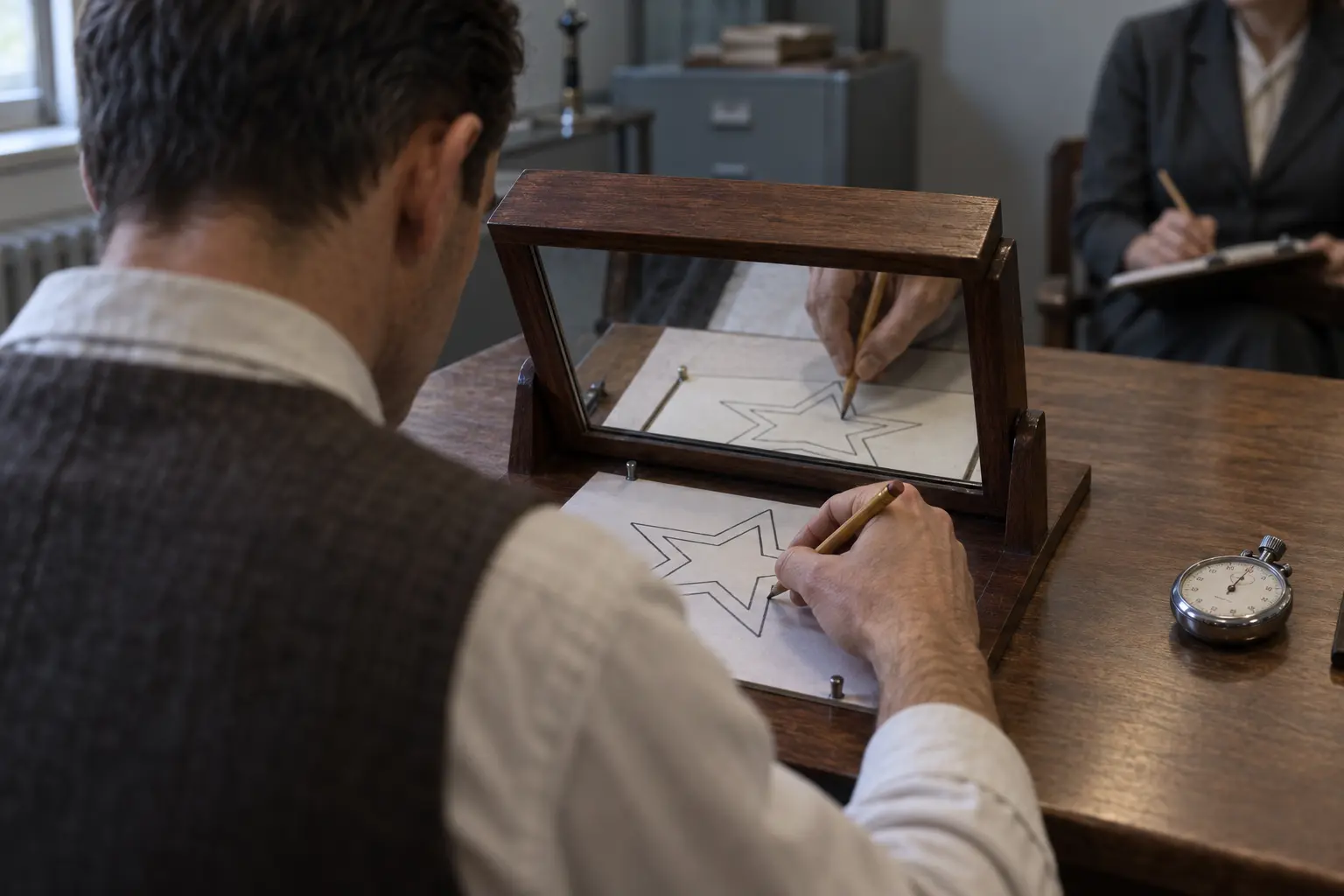
Henry Molaison was asked to trace a star while watching his hand in a mirror. The task reversed ordinary movement: a correction that felt right pushed the pencil the wrong way. Across repeated trials, his errors decreased.
Yet Molaison could not remember doing the task before. A 1953 operation for severe epilepsy had left him with a profound inability to form many new long-term memories. Each session could feel new while his performance quietly carried the past forward.
The contradiction changed neuroscience. It also made one person’s daily life into evidence for decades.
The seizures before the operation
Molaison developed minor seizures in childhood and major seizures in adolescence. By his twenties, the episodes remained disabling despite medication. In 1953, neurosurgeon William Beecher Scoville operated on both medial temporal lobes, removing tissue that included much of the structures then understood as the hippocampal region.
The operation reduced the severity of Molaison’s epilepsy, but the cost was unexpected and permanent. His intelligence, perception, language, and ability to carry on a short conversation remained substantially intact. His capacity to retain new experiences beyond the immediate present did not.
The original 1957 report identified him only as H.M. That anonymity protected his identity while turning the initials into one of psychology’s most recognizable names. The person inside the case remained less visible than the deficit.
Scoville’s operation belonged to an era when surgeons were testing the therapeutic possibilities of removing or disconnecting brain tissue for epilepsy and psychiatric illness. The 1957 paper included several patients with bilateral medial temporal operations, but H.M.’s memory loss was the most intensively studied. Later accounts should not make the procedure seem routine or its consequences inevitable; the operation was an intervention under desperate clinical circumstances whose cognitive cost had not been understood.
A present that would not accumulate
Scoville and neuropsychologist Brenda Milner described a severe loss of recent memory after bilateral medial temporal surgery. Molaison could remember much of his earlier life, attend to a task, and repeat information for a short interval. After attention shifted, new events often failed to become durable memories.
This was not a blank mind. He could read, converse, solve puzzles, and use knowledge acquired before surgery. The impairment exposed a difference between holding information briefly and building a long-term record of an experience.
That difference gave scientists a new anatomical clue. Damage centered in the medial temporal system could devastate memory formation without producing a general collapse of intellect. Later imaging and postmortem work refined the map of what had been removed and disconnected, but the behavioral boundary was visible early.
Molaison’s working memory could support the few seconds needed to understand a sentence or follow the immediate steps of a task. The failure appeared when experience had to cross a longer interval and become retrievable after distraction. He could inhabit a coherent present without building the ordinary archive that lets one present recognize another as its consequence.
The star in the mirror
In the mirror-tracing task, Molaison had to guide a pencil between the lines of a star while seeing the page only through a mirror. Healthy beginners make repeated errors because vision and movement no longer correspond in the familiar way.
Across practice, Molaison became more accurate. The improvement survived from one session to the next even though he lacked conscious recollection of the practice. His nervous system had retained something his autobiographical memory did not supply.
The result helped separate declarative memory—the ability to remember facts and events—from procedural learning, the gradual acquisition of a skill. Scientists no longer needed to speak about memory as if it were a single store that was either present or absent. Different systems could be injured or preserved.
The finding also changed what counted as evidence of remembering. If researchers had only asked Molaison whether he recalled the earlier session, the answer would have suggested that nothing remained. Performance supplied a second measure. Learning could appear in fewer errors, smoother movement, and faster completion even when conscious recognition did not accompany it.
A life measured in visits
Molaison participated in research for more than five decades. Investigators tested recognition, spatial knowledge, language, perception, conditioning, motor learning, and the limits of what he could acquire. Findings from one person became foundations for models of memory used around the world.
The repetition contained a human asymmetry. Researchers could remember years of encounters with him. He often could not remember meeting them. Notes, schedules, relatives, and research staff carried continuity that his own memory could not reliably provide.
Accounts describe him as cooperative and aware that he was helping science, but the ethics cannot be reduced to a single reassuring adjective. Consent is not one signature frozen in time. Profound amnesia raises questions about how permission is renewed, how burden is monitored, who protects the participant’s interests, and how a person’s privacy changes when a case becomes famous.
Those questions do not cancel the research or imply that Molaison was merely used. They require the scientific benefit and the participant’s vulnerability to remain visible together. A study can be enormously valuable and still demand continuing scrutiny of who controls access, interprets behavior, preserves records, and tells the public story.
The map changes after death
Molaison died in 2008. Only then did his full name become widely public. He had agreed to donate his brain, extending the research beyond his life.
In a prolonged postmortem project, the brain was photographed, frozen, and cut into thousands of thin sections for digital reconstruction. The resulting anatomy showed that the surgical lesion was more complex than the simplified textbook phrase that his hippocampi had been removed. Portions remained, while nearby entorhinal and other medial temporal regions had also been damaged or disconnected.
The correction did not erase the earlier findings. It made them more precise. H.M. had taught science that medial temporal structures are critical for forming many lasting memories; the later atlas showed why no single cartoon outline could fully explain his condition.
Postmortem anatomy also reversed the usual direction of a case study. For decades, scientists inferred damaged structures from surgical notes, behavioral tests, and scans. After death, the tissue itself became a new archive. The final map could clarify the lesion, but it could not reduce a lifetime of behavior to one missing region.
What remained
Molaison’s case is often introduced as a discovery story: surgery, amnesia, the star task, a new theory. That sequence is accurate but incomplete. The discovery lasted because a man lived for decades with the consequence.
His preserved abilities prevented researchers from equating memory with intelligence or personhood. He could have preferences, perform routines, respond warmly, and improve at a task even when he could not narrate the learning that produced the improvement.
The scientific language of preserved and impaired functions is useful, but it can sound like an inventory detached from daily life. For Molaison, the boundary meant that a conversation could be meaningful while it happened and still fail to become part of the story he could later tell about himself.
That loss did not freeze him in 1953. He aged, encountered new routines, and responded to a changing world, even when the experiences did not assemble into the continuous personal history most people take for granted.
The pencil line around the star became evidence that a life can carry its past in more than one way. Molaison could not always tell researchers what yesterday had left behind. His hand sometimes could.
More stories from Memento Medica
For more interesting content, follow Memento Medica on YouTube.
Follow Memento MedicaWritten and illustrated with AI assistance for Memento Medica. The lead image is a conceptual reconstruction, not a historical photograph, a likeness of Henry Molaison, or an exact research session. Factual claims were checked against the references listed below.
Sources & what we can know
This original narrative uses the historical term H.M. only where relevant and names Henry Molaison because his identity became public after his death. It does not invent conversations, internal experience, researcher relationships, or a simple account of consent. The anatomical description follows later imaging and postmortem evidence rather than claiming complete bilateral hippocampal removal. Follow Memento Medica for more independently sourced stories from the history of medicine.
- Scoville and Milner: Loss of Recent Memory After Bilateral Hippocampal Lesions (1957)
Original clinical report, full scanned article accessed October 26, 2026. Used for the operation, preserved functions, severe recent-memory deficit, and initial anatomical interpretation.
- Annese and colleagues: Postmortem examination of patient H.M.’s brain
Primary postmortem and digital-reconstruction study; abstract and indexed text read October 26, 2026. Used for life history, brain donation, sectioning, and revised anatomical description.
- National Academy of Sciences: H.M.’s Contributions to Neuroscience
Scholarly review and autopsy context, indexed text read October 26, 2026; direct page later presented a verification barrier. Used for research chronology, preserved learning, identity, and donation.
- Corkin and colleagues: H.M.’s Medial Temporal Lobe Lesion—Findings from MRI
Primary MRI study, indexed text read October 26, 2026; direct page later presented a verification barrier. Used to distinguish the simplified hippocampal account from the broader lesion.
- Frontiers in Human Neuroscience: Motor skill depends on knowledge of facts
Peer-reviewed analysis, relevant sections read October 26, 2026. Used for the mirror-drawing procedure and the distinction between motor learning and conscious recollection.
- Squire and Wixted: The Cognitive Neuroscience of Human Memory Since H.M.
Scholarly review, read October 26, 2026. Used for the history of H.M. research, mirror-tracing result, and the development of multiple-memory-systems theory.