
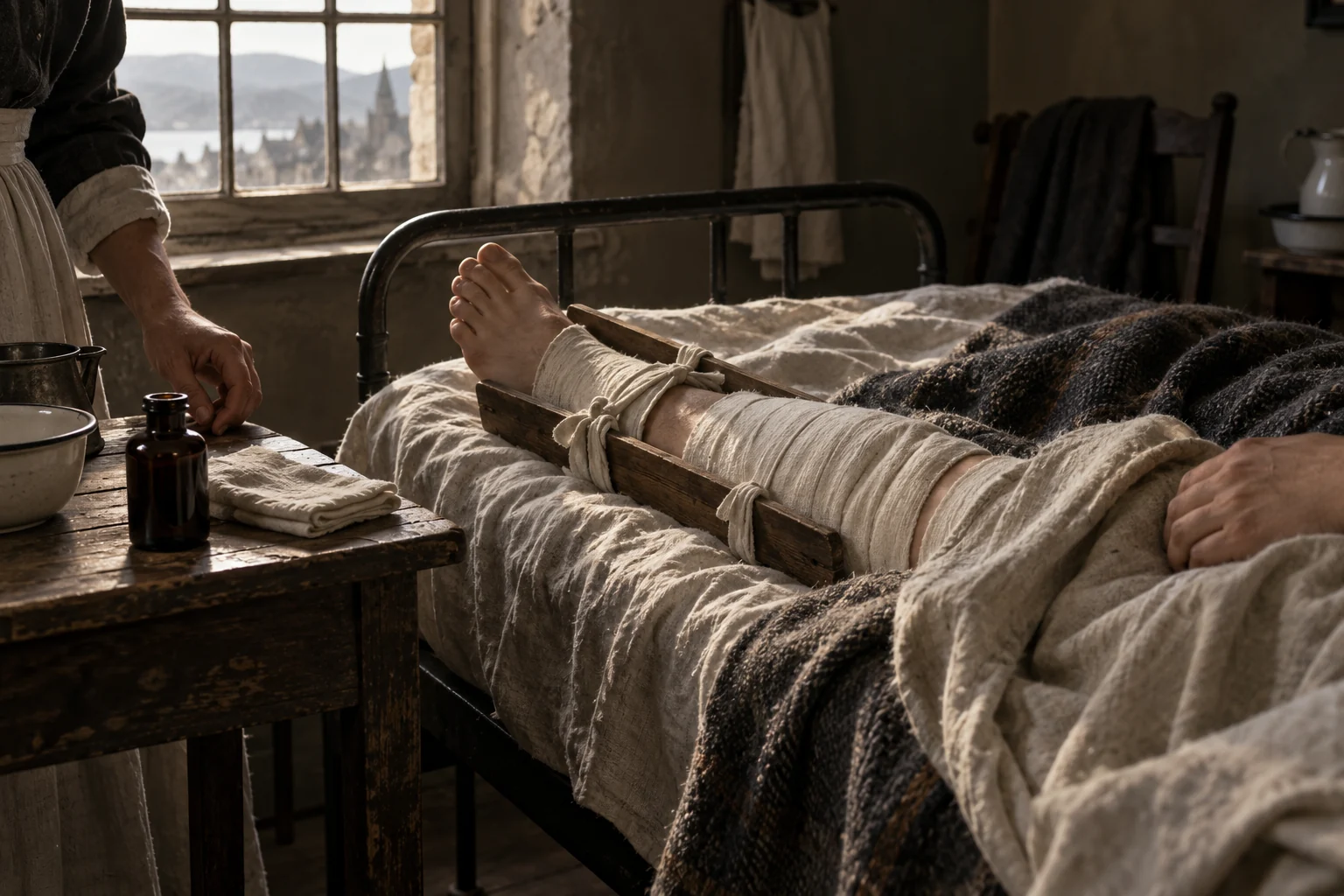
Content note: Historical injury, wound infection and amputation; no graphic description or treatment instructions.
Four days after the first dressing, the boy complained of uneasiness. Joseph Lister examined the wound. There was no sign of the deep suppuration he feared, but the nearby skin was red. The substance intended to protect the injury was also capable of damaging the person beneath it.
The patient was eleven. Lister's 1867 report calls him James G—; the Royal College of Physicians and Surgeons of Glasgow identifies him as James Greenlees. An empty cart's wheel had passed over his left leg. His broken tibia was connected to a wound through the skin. What happened next would enter the history of antiseptic surgery.
The familiar version offers a clean transformation: a surgeon applies an antiseptic, a child recovers, medicine advances. James's actual course is more unsettling. The dressing changed. The skin suffered. A little pus appeared at the surface. And the surgeon who described the recovery admitted that this particular boy might have healed under ordinary treatment.
The opening in the skin
James arrived at Glasgow Royal Infirmary on August 12, 1865. The report describes a wound near the fracture, with a passage beneath the skin to the injured bone and beyond. The break was therefore compound, or open. The problem was more than getting the bone back into position: the injury had breached the body's covering.
For a patient, a successful repair could still be followed by a dangerous deterioration. Lister was trying to understand the relationship between wounds, decomposition and the production of pus. His question concerned what might happen after the immediate mechanical injury had been dealt with. A limb could look properly set while its future remained uncertain.
The surviving report gives measurements and treatment observations. It supplies no conversation with James's family, no description of his journey to hospital and no record of what he expected. His age and the injury are enough to establish the stakes. He was a child whose recovery depended on what other people did to an injured leg.
A chemical between the wound and the world
Lister connected wound decomposition with work by Louis Pasteur on living agents in fermentation and putrefaction. Air itself did not need to be the destructive ingredient. Minute living things carried within it could provide another explanation. If those agents could be checked, the course of an open injury might change.
He chose carbolic acid, now also called phenol. His earlier attention to reports of its use against sewage decomposition helped make it a candidate. But choosing a substance that could oppose decomposition did not establish how safely it could be used on living tissue. The same chemical could be both a proposed protection and a source of harm.
In James's case, the first application was made by house surgeon Dr Macfee under Lister's instructions. Macfee placed soaked lint on the wound and applied padded pasteboard splints. That division of work belongs in the story. The first dressing was an action carried out within a hospital team, rather than a solitary inventor's gesture.
The body answers back
After the first four days, James's discomfort prompted a look beneath the dressing. Lister recorded slight redness nearby but no suppuration. He changed the application. Over the following days, the uneasiness and redness disappeared, while damaged surface tissue attributed to the acid separated.
Then the skin covering became excoriated. Lister changed the dressing again, this time using an oily preparation. A small quantity of pus appeared at the sore's surface, but the report says none came from beneath the skin. Later, a simple water dressing replaced the chemical preparation.
Those details disrupt an easy opposition between dirty old medicine and a perfectly safe new method. The proposed advance needed adjustment on a child's body. The treatment was not a finished technology arriving from outside the ward. Its limits became visible through the wound, the surrounding skin and the boy's complaint.
We should not translate the report into a confident claim that nothing ever went wrong, or that the leg was free of every organism. Lister described what he could observe. Surface pus and tissue damage were present in his account, even though the feared deep suppuration did not develop.
Sources [1]
Six weeks, and a qualification
At six weeks, Lister examined the bones and found them firmly united. He removed the splints. Two days later, he reported that the sore had entirely healed. This is the documented resolution: union and a closed wound, after a course that included changing dressings and watching for trouble.
It does not give us a scene of James running out of the hospital, a family celebration or a lifelong follow-up. Those would be attractive endings, but they are absent from the evidence consulted here. The case's strength lies in the observations that were recorded, including the ones that complicate the celebration.
Lister also acknowledged that James's injury was favorable and might have done well with ordinary treatment. The concession is easy to lose when the boy becomes the emblem of a discovery. Keep it in view and the achievement changes shape. This recovery encouraged further work; it could not, by itself, prove what would have happened without the antiseptic.
Sources [1]
An encouraging case is not a verdict
The report's opening warns that treatment had gradually improved and that the early cases should not be treated as models. That is a revealing instruction to leave inside a founding account. Lister was describing a developing practice, with revisions between one patient and the next.
The next case makes the uncertainty harder to ignore. Patrick F—, a thirty-two-year-old laborer, had a tibial injury after a horse kicked him. His course initially appeared promising. The report later records hospital gangrene and an amputation. A good early appearance did not guarantee the outcome everyone wanted.
We cannot use that contrast as a controlled experiment. The injuries, patients and subsequent care differed. Nor does the report justify blaming a particular person for the deterioration. It shows why a series matters more than one memorable recovery, while also showing why a changing, uncontrolled series has limits.
Historian Michael Worboys describes antiseptic surgery as a practical performance involving materials, handling and technique. An idea needed people who could repeatedly make it work. Its history therefore includes adaptation and argument, rather than a single liquid whose arrival instantly settled every question.
The work outside the famous bedside
Agnes Lister belongs in this wider history. Scholarship identifies her as a continuing partner in Joseph's experimental work, and the Science Museum also recognizes her research partnership. Giving her that place does not require inventing her presence beside James or assigning her a specific dressing she is not documented as applying.
Pasteur's investigations, Macfee's application, Agnes's experimental work and the labor of developing a repeatable method help restore the scale of the undertaking. Their contributions were different. Acknowledging them makes the breakthrough more intelligible than arranging every useful action around one famous pair of hands.
It also changes what counts as medical progress. A proposal must survive contact with tissue, discomfort, imperfect observations and other people's attempts to use it. The practical work of revision is part of the discovery itself. In this case, the patient's skin and complaint helped disclose what the first application could not safely remain.
Leave the boy in the story
Antisepsis aims to oppose the living agents that can contaminate a wound. It is related to, but not identical with, the later aim of keeping contamination out through aseptic practice. Today's surgical safety cannot be reduced to copying an early dressing, and this history offers no instruction for treating an injury with carbolic acid.
James's case remains compelling because its resolution is both concrete and limited. A child with an open fracture healed. The clinician recorded enough of the process to show injury caused by the proposed protection, adjustments made in response and uncertainty about the treatment's individual effect.
The unease is not that the story contains a villain hidden beneath a white coat. It comes from a harder relationship: the patient needed care, and making that care safer required admitting that the method could injure as well as help. Confidence had to remain answerable to the person receiving it.
At the end of the account, the bone is united and the sore is closed. Keep James there, before the honors and the monuments. His recovery matters as his recovery. The history becomes larger when it can remember that, without pretending that one healed leg answered every question.
More stories from Memento Medica
For more interesting content, follow Memento Medica on YouTube.
Follow Memento MedicaWritten and illustrated with AI assistance for Memento Medica. The lead image is an interpretive illustration, not historical evidence. Factual claims were checked against the references listed below.
Sources & what we can know
This original narrative separates Lister’s clinician-authored 1867 report, consulted through its 1909 reprint, from institutional identification and later scholarship. It does not supply James’s thoughts, family testimony, consent conversation or long-term outcome. Healing in one favorable case cannot establish its untreated counterfactual. Agnes’s larger research partnership is distinguished from unverified bedside participation.
- Joseph Lister, On a New Method of Treating Compound Fracture, Abscess, etc. (1867), reprinted in Collected Papers, vol. II (1909), pp. 3–6
Case 1 and 2 read in public-domain OCR; critical printed pages 4–5 visually checked in scans n17–n18. Page 3 framing and page 6 continuation read in OCR. A 1909 reprint of the 1867 report, not the original patient chart. The original abbreviates surnames.
- Royal College of Physicians and Surgeons of Glasgow: The Case of James Greenlees
Institutional identification of the boy as Greenlees; page read October15,2026. Its abbreviated first-case/birth-of-antisepsis account is qualified using Lister’s earlier failed attempt and primary caveat. No artwork reused.
- Michael Worboys, Joseph Lister and the performance of antiseptic surgery (2013)
Substantive scholarly sections read October15,2026. Used for practical technique, evolving protocols and the limits of a single heroic invention narrative.
- Brian Hurwitz and Marguerite Dupree, Learning from Lister: antisepsis, safer surgery and global health (2013)
Substantive text returned by initial search read for Agnes’s experimental partnership; later direct opening presented a challenge. Full facsimile not claimed.
- Science Museum Group: Joseph Lister
Institutional biography read October15,2026 for research partnership and surgical context. Its broad cleanliness/sterility wording is not used to equate the first carbolic dressing with modern asepsis.