
Content note: Historical poisoning and illness; no graphic descriptions.
A room meant to shelter a family could be lined with arsenic. The color did not warn its occupants. It offered flowers, leaves, and the promise of a brighter home.
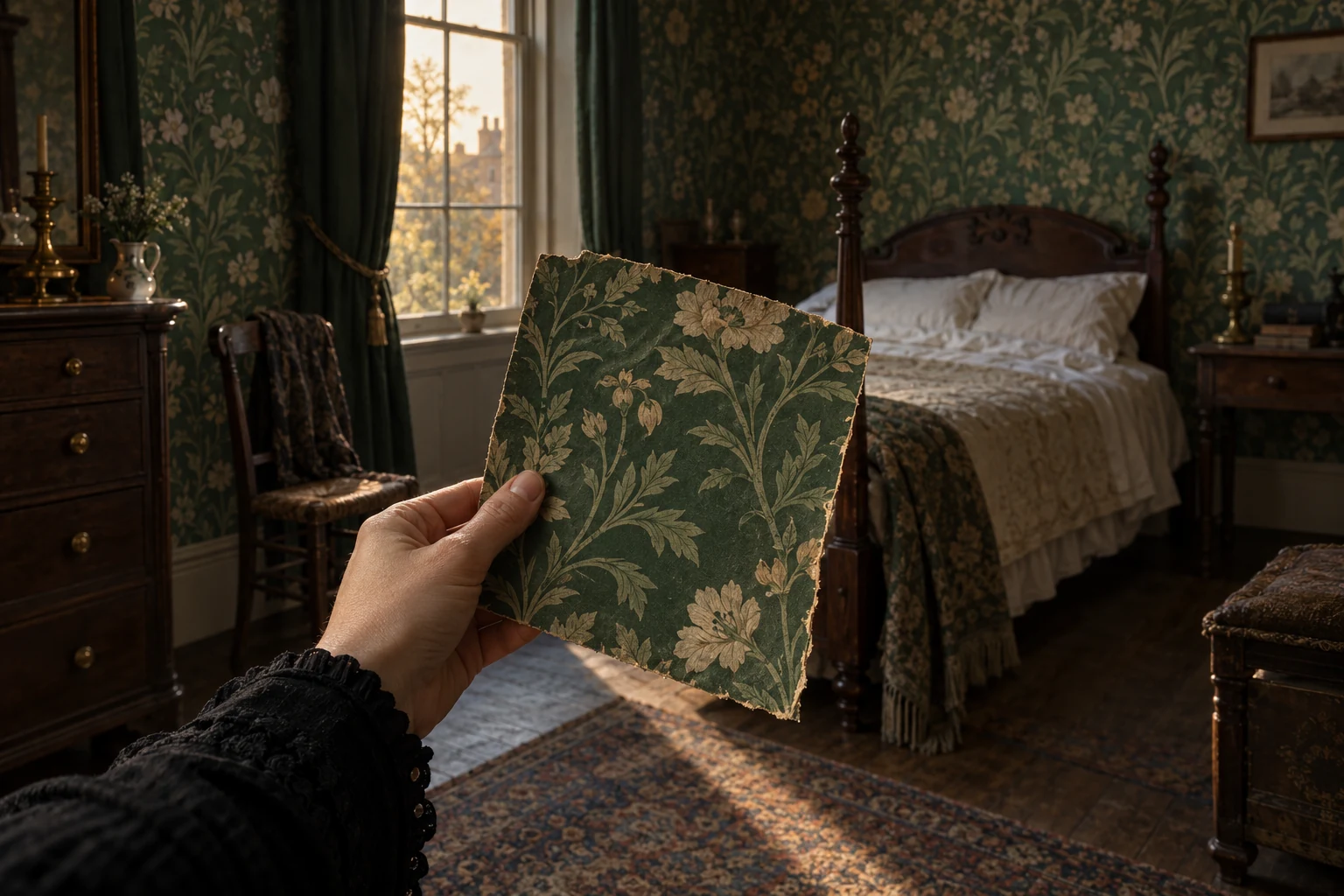
Imagine a nineteenth-century shopper choosing a green wallpaper for a bedroom. This is an imagined purchase, not a recovered scene. The pigment behind it is real: arsenic compounds were used in fashionable papers, fabrics, and other goods. A poison could enter the house as decoration.
How could something so dangerous remain so ordinary? In 1874, physician and chemist Robert C. Kedzie made a warning that people could hold: a book containing actual specimens of arsenical wallpaper. Its unsettling title was Shadows from the Walls of Death.
The book leads back to a harder question than whether a beautiful room might be hazardous. What would make a household question the object it had chosen to make life better? The surviving papers allow us to examine the material. They cannot tell us every illness it caused.
A color worth wanting
In 1775, the Swedish chemist Carl Wilhelm Scheele developed the arsenic-containing pigment that became known as Scheele’s Green. Its copper arsenite chemistry produced an attractive color at a relatively low cost. Other arsenical greens followed. The names differed, but the appeal was easy to understand: bright, durable color that manufacturers could sell.
The surviving objects help explain that appeal better than any lecture. Cooper Hewitt’s collection includes an 1836 wallpaper whose green details outlasted other colors in the design. The pigment’s endurance was part of its attraction. It was a commercial advantage before it became a preservation problem.
Calling these papers poisonous can make the people who bought them seem absurd. Why choose something dangerous for a bedroom? But shoppers were choosing a finished product, not reading a modern laboratory report. Attractive design and widespread availability supplied their own quiet reassurance. If respectable shops carried it, how dangerous could it be?
The answer depended on questions a pattern book could not settle: what was in the pigment, how firmly it stayed attached, how exposure occurred, and how much of it reached a person. Beauty answered none of those questions. It simply made them easier to postpone.
The illness that did not point at the wall
Historical reports connected arsenical wallpaper with symptoms including nausea, headaches, and intestinal distress. Some described people improving when they spent time away from the papered rooms. Yet the symptoms overlapped with other illnesses, and members of the same household did not necessarily become ill in the same way. The National Library of Medicine’s history explains why this made the danger easy to dispute.
An exposure did not require swallowing a sheet of paper. Pigment could flake from its surface, and material could transfer through handling. That possibility makes dose and conditions central to the question. The presence of an arsenical pigment establishes a hazard; it does not establish how much reached any particular person or prove the cause of an individual illness.
Think about the puzzle from inside the house. One person feels unwell; another seems fine. A doctor offers a familiar explanation. The room has looked the same for months. There is no dramatic spill, no obvious accident, no moment that announces an exposure. The most ordinary thing in the room is also the thing least likely to be interrogated.
Concern about wallpaper already belonged to a larger argument about domestic health. The Victoria and Albert Museum describes homes where coal fires, smoky lighting, and urban air left walls dirty. Manufacturers developed washable papers, and buyers weighed appearance against cleanliness. Arsenic and lead in pigments added a more serious question to those debates.
The problem was never as simple as saying that every green room was deadly. Exposure varied, and historical case reports cannot give us a reliable total of wallpaper-related deaths. Nor can they identify the cause of every Victorian illness. A careful account has to leave those limits visible. The documented hazard is disturbing enough without assigning it an invented body count.
The book that brought the walls into the library
In Michigan, physician and chemist Robert C. Kedzie tried an unusual way of making the warning tangible. In 1874 he compiled Shadows from the Walls of Death, a volume containing actual specimens of arsenical wallpaper. One hundred copies were prepared for distribution to Michigan libraries. Readers could encounter the materials themselves rather than relying only on a description.
The title sounds like a gothic novel. The pages were evidence.
There is an extraordinary tension in that choice. To explain why a familiar material could be dangerous, Kedzie placed the material inside another familiar object: a book. The warning could not be separated from the thing being warned about. A library, usually imagined as a shelter for knowledge, had to decide how to preserve knowledge that came with a physical hazard.
Much later, the National Library of Medicine approached digitization as an occupational-safety question as well as a scanning job. Its staff described protective equipment, surface sampling, and air monitoring during the 2017 work. Sampling found arsenic transfer to equipment and gloves; airborne concentrations during that particular operation were below detection.
That last detail matters. A book containing arsenic is not a supernatural object that harms anyone who opens it. The modern account describes measured conditions, specific exposure concerns, and precautions. Precision makes the story more interesting: the danger has a route, a material, and a context. It can be investigated.
What the colors concealed
Museums are still finding out what their wallpaper collections contain. In a study described by the RISD Museum, researchers used X-ray fluorescence to examine nine selected historical wallpapers. All nine contained arsenic. The group was deliberately chosen by color and period, so the result does not mean that all old wallpaper contains arsenic. It means those particular objects did.
The testing also complicated the easy rule that green alone was suspicious. Other colors in some samples contained arsenic, too. Looking at the design could suggest where to investigate, but it could not replace an investigation. A color was a clue, not a chemical analysis.
Historic England’s researchers describe another complication: testing an old wall can pick up materials behind or over the paper being examined. Lead can also interfere with identifying arsenic because their X-ray signals are close. Even an instrument’s reading has to be interpreted. The wall may hold several generations of decoration at once.
This is a satisfying reversal of the original mystery. Where a household once had symptoms and suspicions, conservators now have surviving material and analytical tools. They can ask narrower questions and obtain better answers. But the surviving objects cannot reconstruct every exposure, every bedroom, or every person who became ill. Evidence can clarify a story without completing it.
A room is a promise
The wallpaper story stays with us because a home carries a promise of protection. The walls surround the place where people rest, recover, and stop paying attention to danger. To discover a hazard there is to discover that familiarity has been mistaken for safety.
It also shifts our attention toward the people who made the beautiful things. A finished room hides the work that produced it. The pigment had to be manufactured and handled before a customer ever admired the pattern. The history of decorative objects therefore belongs beside the history of workplaces and exposure, not only the history of taste.
There is no need to turn every modern room into a suspect to understand the lesson. The historical question is more specific: how did an attractive material remain ordinary while evidence against it accumulated? Following that question leads through shops, medical reports, library shelves, and conservation laboratories. Each offers a different way of seeing the same paper.
Look again at the imagined green room. Nothing in its appearance has changed. The flowers still climb the walls. The color still seems alive. What has changed is the knowledge you bring into it.
Sometimes the most unsettling thing about the past is how long a dangerous object could look perfectly normal.
Sources [5]
More stories from Memento Medica
For more interesting content, follow Memento Medica on YouTube.
Follow Memento MedicaWritten and illustrated with AI assistance for Memento Medica. The lead image is a conceptual illustration, not historical evidence. Factual claims were checked against the references listed below.
Sources & what we can know
This original narrative draws on independently checked historical sources. The imagined shopper is a framing device, not a documented person. Museum objects and controlled collection testing establish the material hazard; they do not establish a wallpaper death toll or an individual diagnosis. The nine RISD samples were deliberately selected, not a prevalence survey.
- National Library of Medicine: Kedzie’s 1874 warning and its historical context
Independent historical reference, freshly checked October 5, 2026.
- Victoria and Albert Museum: Wallpaper and hygiene
Independent historical reference, freshly checked October 5, 2026.
- Cooper Hewitt: Toxic Beauty, with a surviving 1836 wallpaper
Independent historical reference, freshly checked October 5, 2026.
- National Library of Medicine: Firsthand digitization and exposure sampling account
Independent historical reference, freshly checked October 5, 2026.
- RISD Museum: Deceptive Decor, original collection testing
Independent historical reference, freshly checked October 5, 2026.
- Historic England: Perilous Pigments, analytical findings and limitations
Independent historical reference, freshly checked October 5, 2026.