Content note: Tuberculosis, family deaths, exhumation, and the burning of human organs; restrained descriptions.
On March 17, 1892, men in Exeter, Rhode Island, opened the resting places of three women from the same family. They were looking for an explanation for an illness that was still taking the living.
One of the dead was nineteen-year-old Mercy Lena Brown. She had died that January. Her mother and older sister had died years before. Her brother Edwin was seriously ill. The disease running through the family was called consumption, the old name commonly used for pulmonary tuberculosis.
The men found human remains, not a creature rising from a coffin. Their search was meant to help Edwin. Instead, it would make his dead sister the center of an explanation she could never answer.
The disturbing question is how a family’s illness became a reason to examine its dead. Following that question takes us from the sickroom to the cemetery, through the gap between knowing the cause of a disease and having a treatment that could save someone.
The sickness that seemed to consume a family
Tuberculosis can cause a prolonged cough, fever, night sweats, fatigue, and weight loss. When infectious disease in the lungs or throat spreads, it does so through the air. It does not travel from the dead by a supernatural hunger. Today we distinguish TB infection from active TB disease; exposure does not mean everyone will become ill on the same timetable.
But a household living through successive losses could see a different pattern: a person died, and another person began to fade. The sequence offered the outline of a story even when it did not reveal the mechanism of disease. A grave became a visible place to direct attention. A microbe remained invisible.
Edwin had sought relief in Colorado before returning to Rhode Island in worsening health. Mercy’s death came while the family was still trying to save him. The historical newspaper accounts gathered in Smithsonian’s reporting describe the neighbors’ proposal: examine the women’s remains for signs that one of them was sustaining an influence over the living.
The surviving reports do not give us a conversation inside the Brown household. What they do establish is repeated bereavement and a seriously ill son. His father, George, was still alive to confront another proposed intervention. Neighbors, doctors, and relatives did not necessarily agree about what it could accomplish. A sickroom could contain several competing explanations at once.
An old remedy in a changing world
The ritual did not belong to a single household. Folklorist Michael E. Bell’s research documents more than twenty New England incidents in which people disturbed relatives’ remains in an effort to stop consumption. Practices varied. Organs might be examined and burned; the ashes might be treated as a remedy for a living relative.
Calling all of this vampire hunting imports a familiar movie into an unfamiliar situation. Bell points out that the word vampire was often supplied by outsiders and newspapers. The participants’ own explanations were less elaborate than the later legend. Credible accounts do not describe corpses climbing out of their graves to stalk the countryside.
An 1896 investigation by George R. Stetson offers another view of the practice. He recorded accounts in southern Rhode Island in which people regarded the ritual as a response to consumption, sometimes without knowing it by the name vampirism. His writing also records disagreement: doctors could reject the explanation while neighbors continued to believe it.
That disagreement is essential. The past was never one enormous room full of people who all believed the same strange thing. Medical judgment, inherited practices, personal experience, and the pressure to try something could exist together in the same community. The cemetery ritual was one proposed answer among others, and it was an answer with consequences.
What the winter preserved
The contemporary account reproduced in Bell’s study described Mercy’s body as comparatively well preserved and reported blood remaining in her heart. She had been dead for a shorter period than the other women, during the coldest part of the year. Ordinary differences in time and conditions provided a reason for differences in decomposition.
For people looking for a sign, however, that difference could appear to single her out. The heart and liver were removed and burned. Accounts say that Edwin received the ashes mixed into a drink. He died about two months later. The ritual had not stopped his illness.
We should resist making the description more grotesque than the sources require. Mercy had already died of a disease. Her remains became the subject of an attempted cure for someone else. The horror lies in that transfer: a young person’s body became a place where other people acted on an explanation she could neither challenge nor consent to.
The surviving reports also have their own angles. A newspaper correspondent was observing an event for readers. A later investigator was interpreting local beliefs. Those records are indispensable, but they are not the same as hearing Mercy or Edwin tell their own stories. Reading them closely means noticing both what they preserve and whose voices they do not contain.
Science had named the cause. A cure was still another matter.
The year is startling. This happened in 1892, a decade after Robert Koch announced his discovery of the bacterium responsible for tuberculosis on March 24, 1882. The cause of the disease had been identified before Mercy’s remains were disturbed.
Knowing a cause and being able to rescue a particular person are different achievements. Effective antibiotic treatment arrived much later. The gap helps explain why a major scientific discovery did not make desperation disappear from a sickroom. It does not make the ritual effective; it makes the context more intelligible.
Modern readers can know the ending before they reach the cemetery. We know ashes could not supply a treatment for tuberculosis. The people considering the ritual did not possess our complete historical view, though contemporary doctors could and did dispute such practices. An honest retelling keeps both facts together: uncertainty about what to do did not mean there was no criticism of what was done.
This is one reason medical history can be more troubling than a ghost story. In a ghost story, discovering the rule may tell the characters how to survive. Here, a scientific rule was coming into view, but the tools needed to change the outcome remained incomplete. Knowledge had advanced farther than the care available to the family.
The person inside the legend
Mercy’s name now appears in vampire stories, tours, and accounts of strange New England history. The label is memorable. It is also an easy way to lose sight of the person who carried the name.
A nineteen-year-old died. Her family had experienced repeated illness and bereavement. After her death, other people turned her remains into evidence for a claim about the living. The record does not establish that she was anything other than a young woman who had tuberculosis. It does establish that the attempt to save Edwin involved disturbing her body.
An eerie account can hold a reader without asking that reader to enjoy her misfortune. The fascination comes from the collision of ordinary human needs: the need to explain, the need to act, the need to keep someone alive. Those needs are recognizable even when the proposed solution is horrifying.
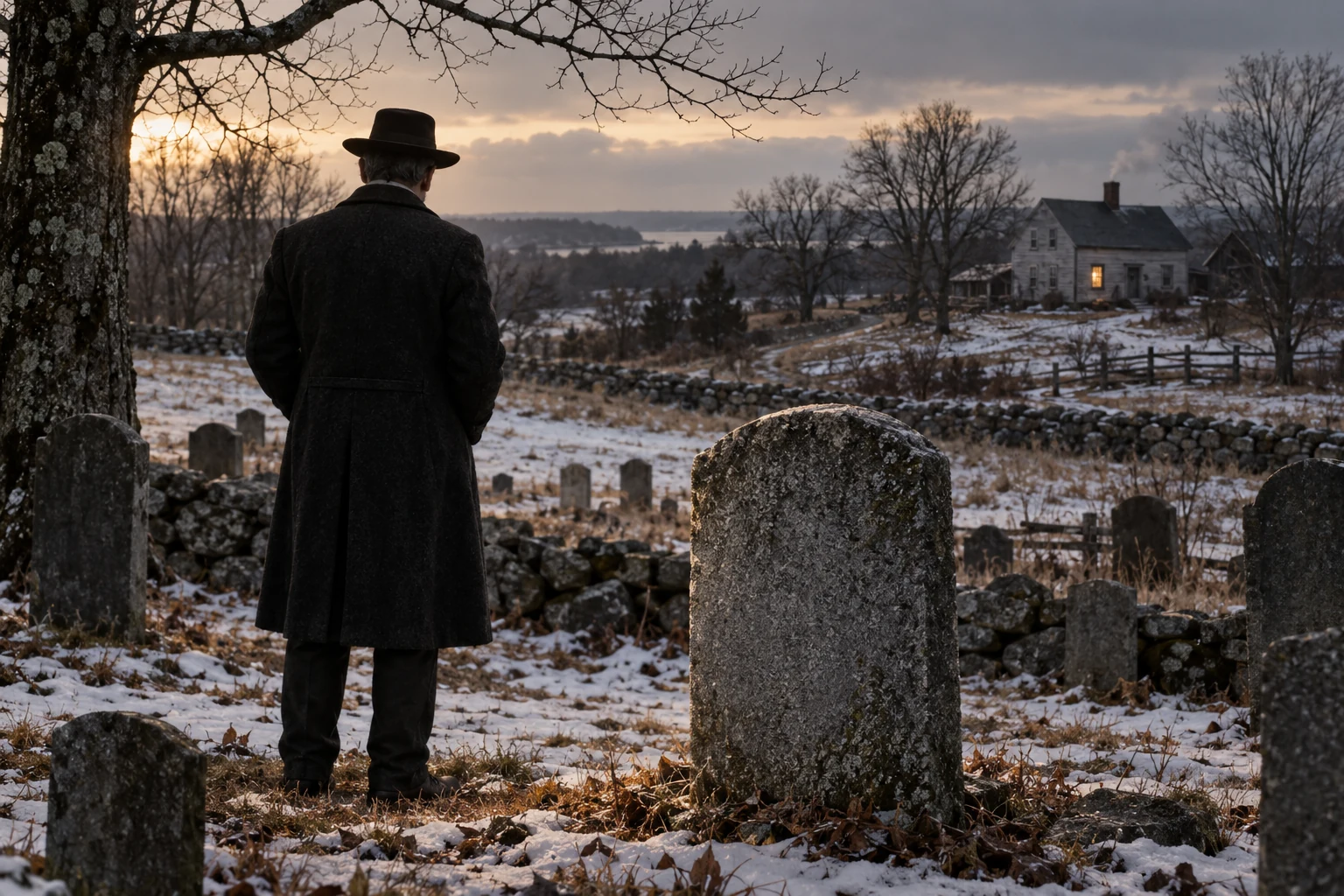
The cemetery gives the story an unforgettable setting, but the crucial drama began before anyone entered it. It began with a terrible question facing a household: what can we do now? Once an explanation seemed to offer an action, doing nothing could feel unbearable. That is an interpretation of the situation, not a claim that we know each participant’s private thoughts.
At the end, the ashes changed nothing about the disease. What endured was the story. We can decide whether to pass along a monster or remember Mercy Brown: a person whose death was made to carry a meaning the evidence did not support.
Sources
More stories from Memento Medica
For more interesting content, follow Memento Medica on YouTube.
Follow Memento MedicaWritten and illustrated with AI assistance for Memento Medica. The lead image is a conceptual illustration, not historical evidence. Factual claims were checked against the references listed below.
Sources & what we can know
This original narrative draws on independently checked historical sources. The 1892 press account was consulted as reproduced in Bell’s historical study; the original newspaper issue was not directly examined. Stetson’s 1896 investigation is outsider testimony with anonymization and imperfect chronology. Private thoughts and dialogue are not reconstructed.
- Michael E. Bell, Vampires and Death in New England, 1784 to 1892 (2006), including reproduced 1892 reporting
Historical scholarship including reproduced 1892 newspaper reporting; the original newspaper issue was not directly consulted.
- CDC: Tuberculosis—Causes and How It Spreads
Current medical reference for airborne spread, inactive infection and active disease; checked October 7, 2026.
- Smithsonian: The Great New England Vampire Panic, archival reporting and historical interviews
Historical reporting and interviews; checked October 7, 2026. Earlier newspaper accounts are mediated through this reporting.
- George R. Stetson, The Animistic Vampire in New England (1896), historical field investigation
1896 outsider field investigation, read in this public facsimile. Anonymization and imperfect chronology limit identification. Canonical bibliographic record: https://www.jstor.org/stable/658266
- CDC: Historical Perspectives—Koch’s Discovery of the Tubercle Bacillus
CDC historical account of Koch’s discovery; checked October 7, 2026.
- CDC: Signs and Symptoms of Tuberculosis
Current medical reference for symptoms; checked October 7, 2026.