Content note: Food contamination, animal processing, and historical public-health hazards; no graphic imagery.
The railcar arrived cold. That did not prove the food had stayed cold.
A shipment could warm while it waited, cool again after fresh ice, and look acceptable at its destination. The final thermometer reading concealed the journey. Bacteria did not forget the warmer hours.
Mary Engle Pennington built her work around that missing history. In laboratories, packing houses, and refrigerated railcars, she linked temperature fluctuations with microbial growth and pushed food handlers to treat refrigeration as an unbroken chain rather than a cold room at either end.
Modern cold storage feels like background machinery. Pennington’s experiments made it a public-health system.
A market stretched beyond sight
At the turn of the twentieth century, growing cities depended on food produced far away. Milk, eggs, poultry, fish, and other perishables moved through farms, packing facilities, rail yards, warehouses, shops, and homes. Each transfer created time, delay, and a new temperature.
Refrigeration expanded what could be sold and when, but it also created distrust. Consumers could not see how long a chicken had been stored or whether eggs had warmed repeatedly. Cold storage was accused of disguising decay, while businesses lost enormous quantities of food to spoilage and poor handling.
The 1906 Pure Food and Drugs Act prohibited food that was filthy, decomposed, or otherwise adulterated. It did not by itself specify a complete microbial standard for every perishable product. Regulators needed evidence connecting handling practices with measurable changes.
Pennington approached that problem as a bacteriologist. The question was not whether cold was generally helpful. It was which temperatures, durations, airflow patterns, containers, and interruptions allowed food to remain usable with lower bacterial counts.
A scientist without the expected path
Pennington was born in 1872 and became fascinated with medical chemistry as a child. She studied chemistry and biology at the University of Pennsylvania, receiving a certificate of proficiency because the institution did not then award the bachelor’s degree to women in the same way. She nevertheless completed a doctorate in 1895.
Credentials did not open the laboratory positions commonly available to men. Pennington created work by teaching and operating a clinical laboratory that performed bacteriological and chemical analyses for physicians. Philadelphia hired her laboratory to investigate milk and other foods at a moment when urban bacteriology was becoming a practical profession.
Her early food work included efforts to improve ice cream and raw-milk handling. These were not glamorous subjects. They connected microscopic contamination with ordinary purchases made for children, households, and crowded neighborhoods.
Harvey Wiley recruited her to federal service after the 1906 law. Her civil-service examination score and existing reputation supported the appointment, while her initials helped an agency request move through a system unused to a woman leading laboratory work. She became the first woman to head an FDA predecessor laboratory.
Cold is a history, not a number
Pennington’s Food Research Laboratory studied how poultry, eggs, milk, cheese, and other products changed during storage and transport. A central finding was that a constant low temperature could restrain bacterial growth more reliably than repeated warming and recooling.
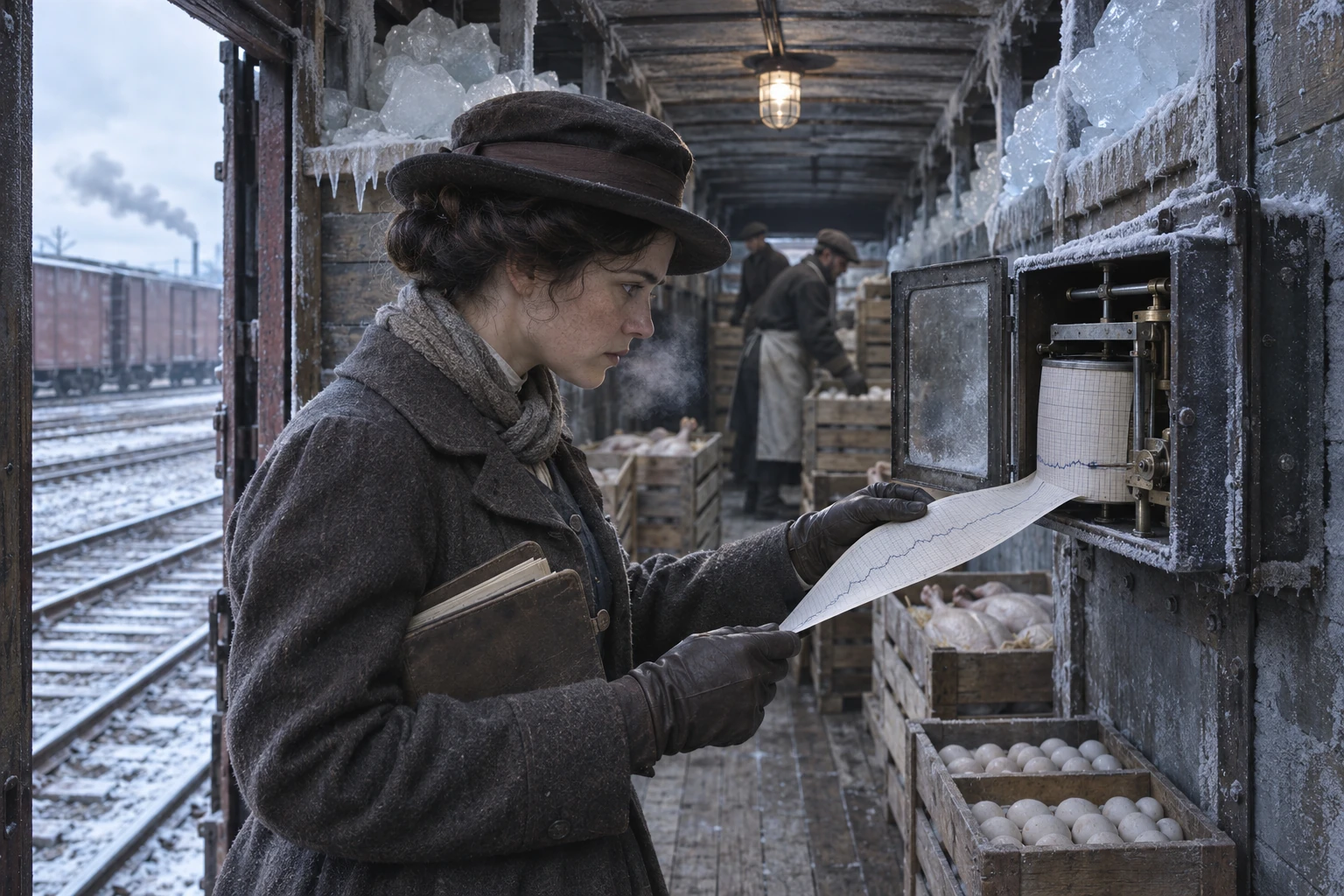
A single temperature taken at arrival could therefore mislead. Food might be chilled when inspected yet carry the consequences of earlier interruption. The useful record was a line over time: when cooling began, where warmth entered, how air circulated, and whether the center of a load cooled as quickly as its edges.
This transformed the meaning of refrigeration. A cold room was one component. Safe handling required coordinated steps from slaughter or collection through packing, storage, transport, retail, and eventually the home. A failure between the links could not always be corrected by making the last link colder.
Pennington’s laboratory measured bacteria rather than relying only on smell or appearance. Spoilage can become visible, but microbial risk and quality loss begin before a consumer necessarily recognizes them. The work helped convert sensory suspicion into reproducible handling evidence.
The important variable was not temperature in isolation but exposure over time. Cooling slows biological and chemical change; warming allows it to accelerate. Repeated swings can therefore accumulate effects that a final cold reading cannot reverse. Pennington’s records made that invisible accumulation legible to inspectors and engineers.
The inside of a railcar
Refrigerated railcars were moving laboratories. Ice bunkers, vents, racks, load density, outside weather, and the placement of crates shaped the temperature inside. Food near a wall could experience a different journey from food in the center.
During the First World War, preserving food became a national logistical problem. The Science History Institute’s account describes Pennington joining work that tested the country’s refrigerated rail system. Temperature instruments placed at different levels showed where cooling failed and how loading patterns blocked air.
Pennington reportedly completed hundreds of rail trips during this period, sleeping in cabooses and observing the chain at crossings, yards, and packing points. The number is striking, but the method matters more: she followed the system instead of assuming the laboratory bench contained the whole problem.
Her team also tested racks and processing methods. A metal poultry-cooling rack allowed air to circulate around carcasses rather than trapping warmth where birds touched. The design joined microbiology with engineering; better evidence mattered only if workers could use it.
Persuasion across a chain
Food safety could not be achieved by publishing a bacterial count. Farmers, slaughterhouses, railroads, warehouse operators, retailers, inspectors, and households all controlled a portion of the journey. Each faced different costs and incentives.
Pennington often worked with industry groups, explaining that sanitary handling and reliable refrigeration protected both consumers and businesses. Reduced spoilage meant less waste. Confidence in cold-stored food expanded markets. Public protection and commercial efficiency could reinforce each other when standards were credible.
She also guarded the role of her federal laboratory. FDA’s history notes that she resisted having laboratory staff turned into courtroom witnesses, preferring to keep the group focused on research. That choice did not remove the work from regulation; it defined the laboratory as the place where methods and standards were built.
In 1919, Pennington left federal service and continued working on food preservation and refrigeration. Her later consulting extended the cold chain toward frozen foods, commercial equipment, and the refrigerator in the home.
Standards also required translation. A bacteriological finding had to become a loading rule, a rack, a thermometer position, an icing schedule, or a cleaning practice. That translation could fail if it demanded equipment a small handler could not afford or if responsibility disappeared at the boundary between companies. Pennington’s systems view kept the boundary itself under scrutiny.
What the line remembers
Calling Pennington the inventor of the cold chain would be too simple. Refrigeration, rail transport, ice production, bacteriology, regulation, and commercial standards developed through many people and institutions. Her contribution was to make their connection measurable and difficult to ignore.
The chain also did not eliminate foodborne illness. Cooling slows many microbes; it does not sterilize food, repair contamination, or replace sanitation. Different foods and organisms require different controls. Historical achievements should not be turned into generic modern safety instructions.
What remains powerful is the idea of continuity. A product has a history even when the buyer sees only its final state. Pennington followed that history through time and space, asking what happened before the door opened and the thermometer was read.
The railcar could arrive cold. The paper line could show that it had not always been cold. In the distance between those two facts, Mary Engle Pennington found the scientific basis for a safer journey.
The same logic now extends far beyond poultry and eggs, but this story does not assign every later refrigerated technology to Pennington. Her documented contribution belongs to an earlier problem: demonstrating that a perishable product’s safety and quality depend on a continuous, observable journey rather than a reassuring temperature at the finish.
More stories from Memento Medica
For more interesting content, follow Memento Medica on YouTube.
Follow Memento MedicaWritten and illustrated with AI assistance for Memento Medica. The lead image is a conceptual reconstruction, not an archival photograph, a likeness of Mary Engle Pennington, or a documented railcar inspection. Factual claims were checked against the references listed below.
Sources & what we can know
This original narrative does not claim that Pennington invented refrigeration, built the cold chain alone, or that low temperature makes food sterile. It separates documented laboratory findings from later system-wide adoption and does not provide modern food-safety advice. Follow Memento Medica for more independently sourced stories from the history of medicine.
- FDA: Mary Engle Pennington—The Cold Chain of Food Safety
FDA History Office exhibit, read November 2, 2026. Used for education, federal appointment, laboratory findings, temperature fluctuation, and career chronology.
- Science History Institute: Mary Engle Pennington
Institutional scientific biography, read November 2, 2026. Used for clinical laboratory work, railcar research, equipment design, wartime logistics, and later consulting.
- Smithsonian Institution Archives: Mary Engle Pennington (1872–1952)
Archival collection record, read November 2, 2026. Used for education, USDA career, and scientific recognition.
- PubMed: Regulating what we eat—Mary Engle Pennington and the Food Research Laboratory
Scholarly historical article record, read November 2, 2026. Used for the laboratory’s regulatory and food-system context.
- Journal of Agricultural & Food Information: Establishing the Cold Chain
Peer-reviewed historical abstract, read November 2, 2026. Used for poultry and egg research, the unbroken-chain concept, and 1907–1919 scope.
- Mary E. Pennington: Relation of Cold Storage to the Food Supply and the Consumer
Pennington’s 1913 article record, read November 2, 2026. Used as a primary source for her public explanation of cold storage, with full-text access limits retained.