Content note: Infectious disease, deaths, forced medical testing, and prolonged confinement; no graphic imagery.
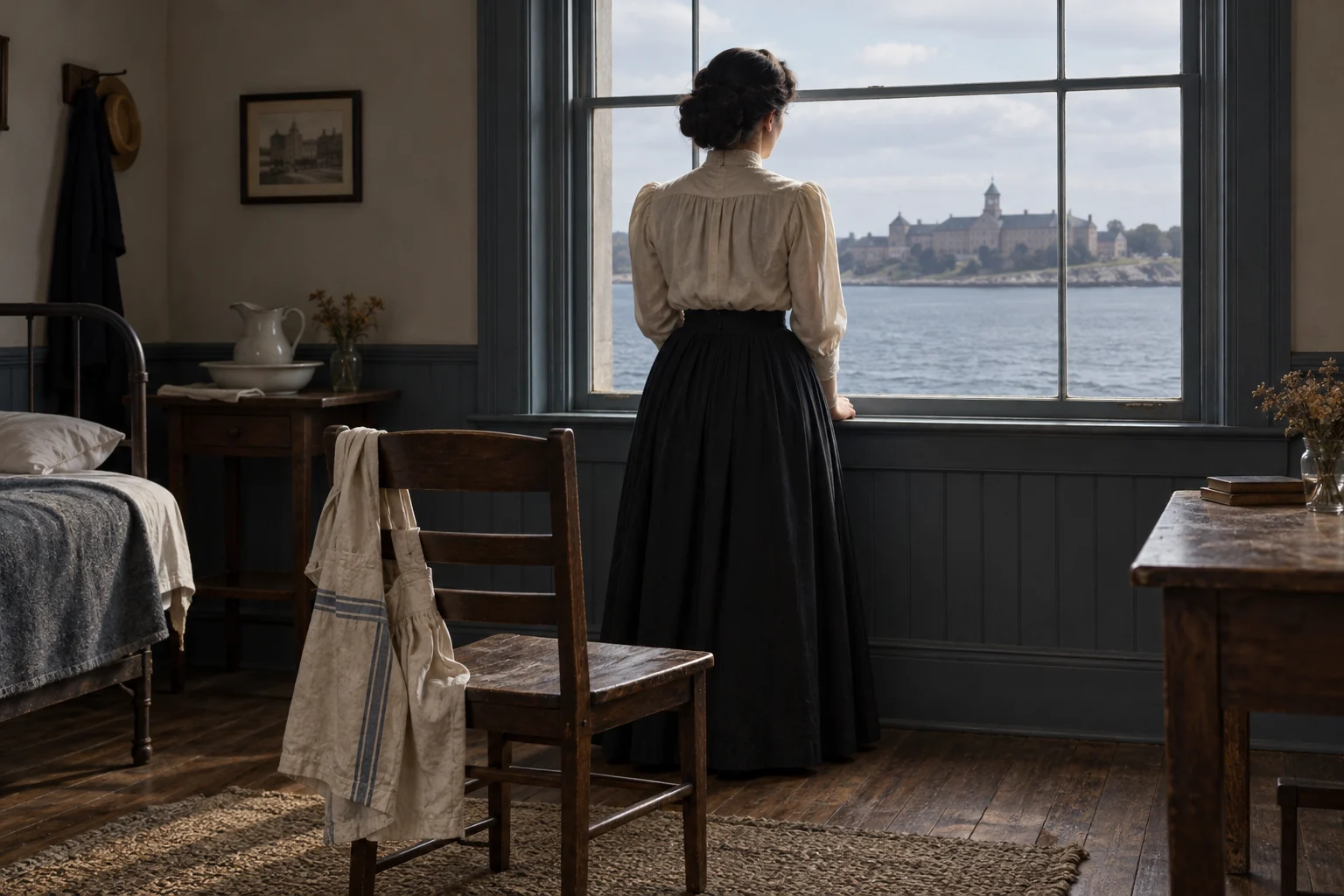
In 1910, Mary Mallon was allowed to leave North Brother Island. Her freedom came with a condition: she must stop cooking for other people. For a woman whose work was cooking, the way out of confinement led through the loss of her occupation.
She had spent nearly three years under the authority of New York’s Department of Health. She was not serving a criminal sentence. Officials said that her body carried the bacteria that caused typhoid fever, and that allowing her to prepare food could put other people in danger. She appeared healthy. Laboratory cultures told a different story.
The bargain placed the same body on both sides of an invisible boundary. Away from a kitchen, Mallon might be permitted an ordinary life. Preparing someone else’s meal could turn her into a public-health emergency again.
Five years later, she would be back on the island. Between those departures and returns lies something more difficult than the familiar nickname “Typhoid Mary”: a person whose livelihood, freedom, and understanding of her own health had become entangled with a danger she could not see.
The house with an unexplained fever
The investigation began with a summer house at Oyster Bay, Long Island. In late August and early September 1906, six people in a household of eleven developed typhoid. The people who became ill included members of the family and domestic workers. Money and a desirable address had not kept the disease outside.
George Soper, a sanitary engineer, investigated after earlier inquiries had failed to establish a satisfactory cause. His 1907 report followed the water supply, drainage, shellfish, and other possibilities before turning to the household’s new cook. Mallon had started work a few weeks before the outbreak.
The problem was larger than a damaged holiday. The owner wanted an explanation that would allow the property to be rented again. An outbreak threatened the value of a house; the search for its cause would eventually threaten a worker’s ability to live anywhere she chose.
Soper reconstructed parts of Mallon’s employment history and found a repeated association with typhoid outbreaks. His account also admitted gaps. Investigating backward meant relying on memories, earlier reports, and incomplete knowledge of a servant’s movements. The pattern was alarming, but following a pattern through old households was not the same as watching a particular meal transmit infection.
Sources [1]
A healthy body becomes evidence
In March 1907, health officials forcibly detained Mallon and obtained specimens for testing. Soper reported that her stools repeatedly contained typhoid organisms. The evidence no longer consisted only of illnesses that followed her from job to job. Bacteria had been recovered from her body.
Soper’s 1919 account also records stretches of negative tests followed by positive ones. A negative specimen did not establish a lasting end to carriage. That uncertainty narrowed the route to proving herself safe: feeling well was insufficient, and a reassuring result could be overturned by later evidence.
What a person feels and what a body can transmit are different things. Today, the Centers for Disease Control and Prevention explains that Salmonella Typhi can pass in feces from people who remain infected after illness. Someone can swallow the organisms in contaminated food or water. Food touched by inadequately washed hands can provide a route from one person’s intestines into another person’s mouth.
That route gives an ordinary kitchen its terrible significance. A meal need not look spoiled. The threat does not announce itself in the face of the person preparing it. Cooking for others brings one body’s hidden biology into the most intimate daily routines of another.
Modern research helps explain how carriage can persist. In a 2010 study, researchers examined human gallstones and a mouse model using a related Salmonella strain. They found bacterial biofilms on stones from human carriers: attached communities that can help bacteria persist. The gallbladder can become a reservoir even without obvious illness.
This is modern evidence about a mechanism, not a microscopic reconstruction of Mallon’s organs. It cannot establish exactly how her carriage began or supply a proven account of her gallbladder. It does explain why looking healthy cannot settle whether someone carries an infection.
The person behind the specimen
Mallon was moved to North Brother Island, where New York maintained Riverside Hospital. Her confinement made an unusual medical condition into the organizing fact of her life. Decisions about where she could live and what she could do now belonged to people interpreting her laboratory results.
She challenged her detention. The Library of Congress’s historical timeline records her unsuccessful 1909 habeas corpus proceeding. The question was no longer simply whether bacteria were present. It was what that evidence allowed the government to do to a person who had not been convicted of a crime.
The surviving record is uneven. Soper was both an investigator and a forceful interpreter of the woman he investigated. His later account supplied judgments about her character alongside observations about disease. These are not interchangeable kinds of evidence. His confidence about the danger cannot give us direct access to her thoughts.
There is no need to invent those thoughts to recognize the predicament. Repeated testing made bodily waste consequential to personal liberty. A healthy appearance could no longer serve as a convincing argument for release. Even disagreement could be read as evidence that she could not be trusted outside. The people measuring the danger also held the power to decide how much of her life it justified taking.
Freedom with an occupation removed
The release in 1910 followed a change in the leadership of the health department. Mallon agreed to avoid cooking and other work involving food. New York’s own bicentennial history reproduces her release letter, a small official document marking a very large change in her circumstances.
The prohibition addressed a real route of transmission. It also required more than knowing a rule. A person needed work, income, and a way to build a life around the restriction. Soper himself acknowledged Mallon’s skill and ability to obtain desirable cooking positions. The occupation she was required to abandon was one in which she had demonstrated value.
Accounts of her subsequent employment are incomplete. Wellcome Collection’s history describes laundry work after her release and treats economic difficulty as a possible reason for her return to cooking. Possibility should remain possibility. We cannot choose a single motive, turn it into a private confession, and make the missing years neatly explain themselves.
Whatever her reasons, the condition of her release mattered. The later return to food preparation exposed other people to a known risk. Understanding the cost of a restriction does not make the risk disappear; recognizing that risk does not tell us whether officials had done enough to make a safer livelihood possible.
The hospital kitchen
In 1915, typhoid broke out at Sloane Hospital for Women in Manhattan. Mallon had returned to cooking under the name Mrs. Brown. The illness affected nurses and other attendants; the outbreak included deaths. A place organized around care had become a place where care workers were endangered.
This was a consequential change in her story. Before the first detention, she had not received the warnings that later accompanied her release. Now there was an agreement, a return to prohibited work, and another outbreak. Officials could point to a specific reason to doubt that the restriction would hold outside custody.
But the evidence still has limits. A warning delivered is not a transcript of what its recipient believed. Soper’s retrospective certainty about what Mallon understood cannot establish an intention to injure. We can describe the dangerous conduct without inventing either murderous intent or complete innocence.
Mallon was sent back to North Brother Island. This time she did not regain her freedom. The health department’s own history records that she remained there until her death in November 1938. A decision made in response to an outbreak became the geography of the rest of her life.
A danger that did not produce an equal sentence
Mallon was not the only healthy carrier authorities encountered. Even Soper’s 1919 account acknowledged that other carriers remained at liberty. Her case cannot be explained simply by saying that the laboratory had discovered a condition that always led to lifelong confinement.
Wellcome’s history offers a striking comparison. Alphonse Cotils, a bakery owner forbidden to continue food work, received a suspended sentence in 1924 after continuing to work in his bakery. That comparison does not make the circumstances identical. It shows that even violating a food-work restriction did not inevitably produce Mallon’s outcome.
Sex, immigrant status, money, occupation, reputation, and the authorities’ assessment of future conduct all belong in the examination of that difference. The available evidence does not isolate one as the sole cause. It does show why the question of fairness cannot be dismissed by pointing to a positive culture. Biology identifies a hazard; institutions decide which person must bear which burden.
The people who fell ill deserve a place in this story. So does the cook whose name became shorthand for contamination. Reducing either side to an obstacle makes the conflict easier to narrate and harder to understand.
The 1910 release letter survives in the city’s historical record. For a brief interval, it opened the way back from the island. Its condition was attached to a job; the danger was attached to a body. Mallon could leave the kitchen. She could not leave that body behind.
More stories from Memento Medica
For more interesting content, follow Memento Medica on YouTube.
Follow Memento MedicaWritten and illustrated with AI assistance for Memento Medica. The lead image is an interpretive illustration, not historical evidence. Factual claims were checked against the references listed below.
Sources & what we can know
This original narrative distinguishes Soper’s 1907 investigation and interested 1919 retrospective account from institutional histories and modern primary research. The archive preserves much more of officials’ voices than Mallon’s inner life. No dialogue, private thoughts, motive, psychiatric diagnosis, exact lifetime death total, or confirmed gallbladder/autopsy finding is invented. Later health-policy comparisons do not establish identical circumstances or a sole cause of unequal treatment. Follow Memento Medica for more independently sourced stories from the history of medicine.
- George A. Soper, The Work of a Chronic Typhoid Germ Distributor (JAMA, 1907)
Full four-page scan of JAMA 48 (24), 2019–2022 read in extracted text on October 15, 2026. Contemporary investigative report; gaps and retrospective outbreak attributions remain visible. The opening of page 1 includes the end of an unrelated article, excluded from use.
- CDC: About Typhoid Fever and Paratyphoid Fever
Official modern account of fecal shedding and contaminated food/water transmission, read October 15, 2026. Used to explain a route, not to reconstruct Mallon’s hand hygiene at a particular meal.
- Robert W. Crawford and colleagues, Gallstones play a significant role in Salmonella spp. gallbladder colonization and carriage (PNAS, 2010)
Primary research article; abstract, introduction, and results text accessed October 15, 2026. Human carrier gallstones and a Salmonella Typhimurium mouse model are distinguished. Later site requests redirected to cookie handling; the original full-text response was accessible. Not evidence about Mallon’s particular gallbladder.
- George A. Soper, Typhoid Mary (The Military Surgeon, 1919), university-hosted transcription
Full university-hosted transcription read October 15, 2026; OCR/transcription errors visible. Used for release conditions, admitted gaps, recognition of cooking skill, other carriers at liberty, and source-perspective analysis. Soper’s character judgments are not adopted as facts about Mallon’s psychology.
- Library of Congress: Typhoid Mary, Topics in Chronicling America
Official archive guide/timeline and selected-articles list read October 15, 2026. Guide checked for detention, 1909 proceeding, 1910 conditional release, and 1915 return. Linked newspaper pages returned 403 and were not claimed as read. The guide’s patient-zero shorthand and typhus wording are not adopted.
- Anna Faherty, The cook who became a pariah (Wellcome Collection, 2017)
Institutional medical-history essay read in full October 15, 2026. Used for the Cotils comparison, employment context, and unequal treatment; its speculative private-thought narration is not adopted. No claim of a single proven discriminatory cause.
- NYC Department of Health and Mental Hygiene: Protecting Public Health in New York City, 200 Years of Leadership (2005)
Relevant Mallon passages at PDF pages 24 and 26 (printed pages 22 and 24) read October 15, 2026; screenshot access succeeded for PDF page 26 and timed out for page 24. Official history reproduces the 1910 release letter and confirms the second confinement/death. Reproduced letter not transcribed or quoted; conflicting historical case counts excluded.