Content note: Infant illness and mortality, poverty, crowded housing, and historical child-care practices; no graphic imagery.
Yesterday’s births arrived as a list.
In 1908, New York City’s new child-hygiene program used records from the Bureau of Vital Statistics to direct nurses toward homes with newborn babies. The paper did not say which family needed clean milk, help with feeding, a clinician, or simply someone who could explain what signs meant danger.
S. Josephine Baker assigned 83 nurses to begin finding out. The visits were one part of a network that would include milk stations, midwife training, well-baby work, school health, and public education.
The intervention was not a single cure. It was a city learning to connect records with doors.
The distance between medicine and a home
At the beginning of the twentieth century, New York’s infant deaths were concentrated in neighborhoods shaped by poverty, crowding, unsafe milk, infectious disease, dangerous work, and limited access to trustworthy care. A hospital or physician could treat a sick baby, but treatment often began after the conditions producing illness had already done harm.
Baker encountered this gap through medical inspection and public-health work. She had trained at the Woman’s Medical College of the New York Infirmary and interned at the New England Hospital for Women and Children. In city service, she entered homes and schools rather than waiting for patients to enter a private office.
Her career followed a family disruption. When her father died while she was a teenager, Baker gave up a planned Vassar education and pursued medicine as a profession that could support her family. That decision did not predetermine public health, but it placed economic security and care within the same life story.
By 1907, Baker was working at a senior level in the health department. The next year the city created a Division, later Bureau, of Child Hygiene and appointed her to lead it—the first municipal organization of its kind in the United States.
Summer intensified the danger. Heat accelerated milk spoilage and diarrheal disease, while crowded rooms offered little relief. Seasonal mortality could rise quickly, making the interval between a birth, a feeding problem, and medical attention a practical target for the department rather than an inevitable feature of city life.
A list becomes a route
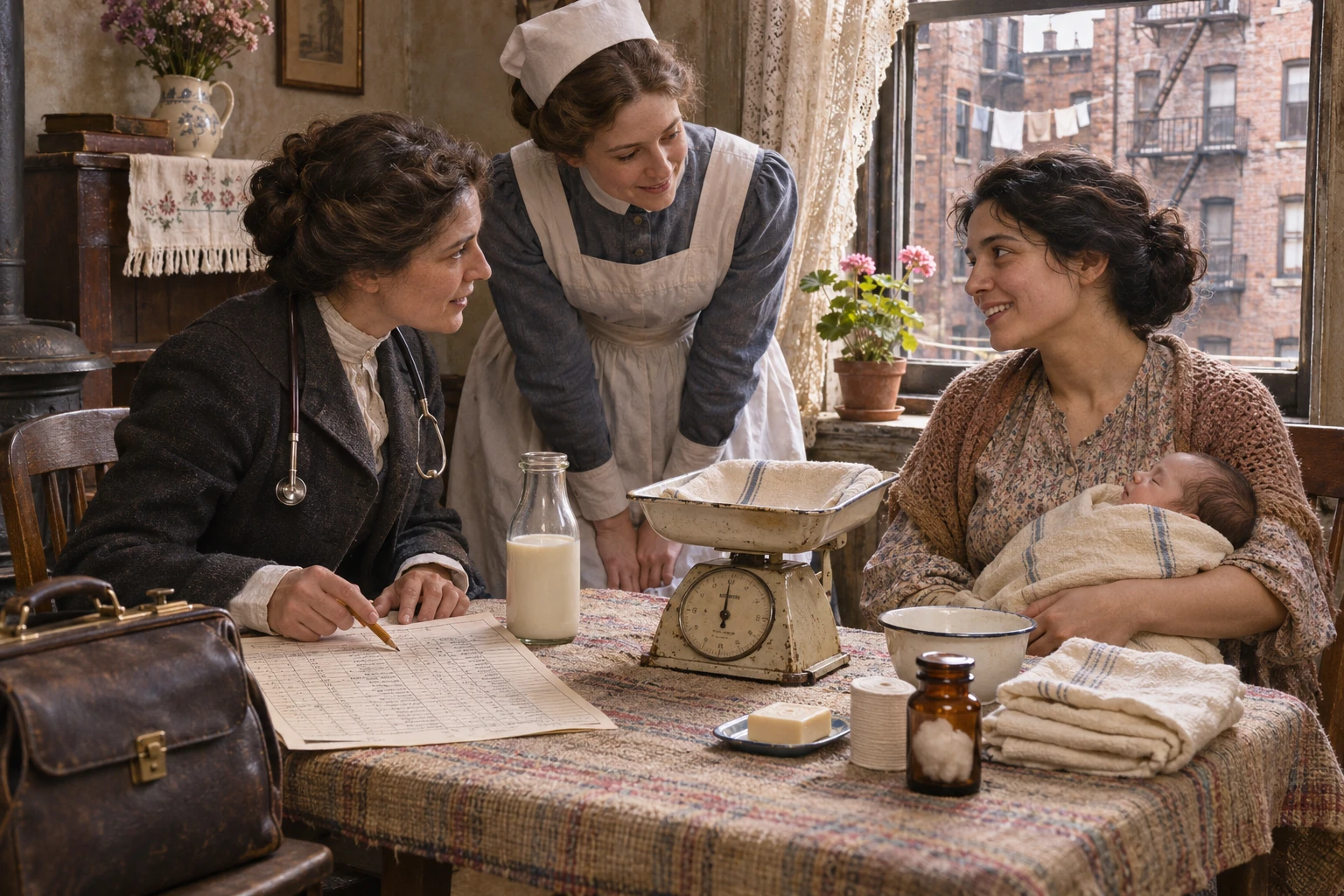
The program’s birth lists came from records filed the previous day. Eighty-three nurses used them to locate mothers and newborns. In each home, a nurse could assess whether an infant appeared ill, ask how feeding was going, and offer instruction about bathing, clothing, ventilation, and care.
The system tried to reach families before illness became an emergency. That was a change in timing as much as a change in personnel. Public health was no longer only quarantine, inspection, or response to an epidemic. It could make preventive contact during an ordinary week.
A record does not create trust. Nurses entered homes where official visitors might represent surveillance, judgment, or removal as easily as help. Baker’s own writings emphasized education, but the encounters still occurred across differences of class, language, immigration status, and institutional power.
The birth list made outreach possible; the nurse had to make it human. Advice had to fit crowded rooms, work schedules, available food, and the practical knowledge of mothers who already cared for families under pressure.
Using vital records this way was an early form of population health surveillance. It made the city capable of acting on a pattern, but it also turned private family events into administrative signals. The ethical value depended on what followed the record: useful assistance, respectful consent, and proportionate action rather than punishment for poverty.
Milk, midwives, and connected work
Infant feeding occupied a central place because contaminated milk could carry lethal infections. The city supported milk stations that distributed safer milk and offered guidance. By 1911, the program’s stations dispensed hundreds of thousands of quarts, and the number of stations continued to grow.
Milk alone could not address the whole pattern. The Bureau trained and supervised midwives, developed well-baby services, expanded school health, and distributed information. Baker argued that reducing infant mortality required preventing illness, not merely treating infants after they became sick.
Some programs reflected the era’s assumptions. Little Mothers’ Leagues taught girls, often young adolescents already responsible for siblings, how to care for babies. The training could offer useful knowledge while also accepting that girls bore adult caregiving labor because families lacked other support.
The Bureau therefore combined practical help with the limits of Progressive-era reform. It improved access and coordination without removing poverty, unsafe housing, unequal work, racism, or the expectation that women and girls absorb the burden of care.
The citywide decline and its limits
New York’s infant mortality fell substantially during the years of Baker’s leadership. City histories associate the child-hygiene programs with that decline, and by her retirement in 1923 the city compared favorably with other large American cities.
It would be careless to assign the change to one person or one bureau. Safer water and milk, sanitation, housing changes, improvements in obstetric and pediatric practice, economic conditions, demographic shifts, private charities, nurses, midwives, families, and other public agencies all contributed.
Baker herself warned against placing too much emphasis on a single method when explaining mortality. Her 1913 writing treated infant mortality as a public-health problem with many interacting causes. Later reflections emphasized that safer milk had already driven an earlier decline and that new gains required broader preventive work.
The strongest claim is therefore structural: the Bureau helped make infant survival a continuing responsibility of municipal government. It linked data, home visits, clinical referral, education, and material support instead of treating each death as an isolated household tragedy.
Mortality statistics also compress unequal experiences. A citywide rate cannot show which neighborhoods improved first, which families remained unreached, or how mothers evaluated the advice they received. The numbers can document an important change without supplying a complete moral account of the program.
Authority in a skeptical profession
Baker directed a staff that included male physicians in a profession often hostile to women’s authority. She adapted her clothing and public manner to move through government spaces where competence was judged through gendered expectations.
In 1917, she became the first woman to earn a doctorate in public health from New York University and Bellevue Hospital Medical College. Her teaching and writing helped spread child-hygiene models beyond New York, and similar programs appeared in other cities and states.
Administrative success can hide collective labor. The daily system depended on nurses walking routes, clerks processing records, laboratory workers testing milk, midwives changing practice, physicians accepting referrals, and families deciding whether official advice was useful.
Baker deserves credit for designing and defending the network. Giving her sole credit would repeat the very problem a network was meant to solve: mistaking one visible point for the whole system.
What yesterday’s paper could do
A birth record is an administrative fact. In Baker’s program, it became a prompt for preventive care. The transformation required government to decide that a healthy baby was not only a private family concern but part of the city’s obligation.
That obligation was imperfect. Early public health could be paternalistic, coercive, and shaped by prejudice. Education offered in a home could support a mother or imply that officials blamed her for conditions produced by low wages, unsafe buildings, or inaccessible care.
The history matters because both possibilities can be true. A nurse’s visit could bring useful help, and the institution sending her could still carry unequal power. A falling mortality rate could show real progress without proving that every program was humane or that one reform caused the entire change.
Yesterday’s births arrived as a list. Baker’s achievement was to make the list move—through nurses, stations, schools, and clinics—toward people who might otherwise meet the health department only after a crisis.
More stories from Memento Medica
For more interesting content, follow Memento Medica on YouTube.
Follow Memento MedicaWritten and illustrated with AI assistance for Memento Medica. The lead image is a conceptual reconstruction, not an archival photograph, a likeness of S. Josephine Baker, or a documented home visit. Factual claims were checked against the references listed below.
Sources & what we can know
This original narrative does not invent home visits, dialogue, family outcomes, or private motives. It treats citywide mortality decline as multi-causal, credits nurses and families, and retains the paternalism and unequal power possible in early public-health outreach. Follow Memento Medica for more independently sourced stories from the history of medicine.
- National Library of Medicine: Dr. S. Josephine Baker
NLM biography, read November 2, 2026. Used for education, public-health career, Bureau leadership, programs, doctorate, and retirement context.
- New York City Department of Health: Protecting Public Health in New York City
Official historical booklet, relevant pages read November 2, 2026. Used for the birth-list system, 83 nurses, milk stations, Little Mothers’ Leagues, and city program chronology.
- S. Josephine Baker: Dr Joe—Pioneer of Public Health Initiatives
Reprinted historical writing in the American Journal of Public Health, read November 2, 2026. Used for Baker’s prevention framework and her account of changing infant-mortality patterns.
- Sara Josephine Baker (1873–1945), American Journal of Public Health
Scholarly historical profile from the NLM History of Medicine Division, read November 2, 2026. Used for biography, administration, and program context.
- JAMA Pediatrics: The Reduction of Infant Mortality in New York City
Baker’s 1913 article record, read November 2, 2026. Used for her caution about causal attribution and the framing of infant mortality as a multi-factor public-health problem.
- Library of Congress: Healthy Children by S. Josephine Baker
Primary-source book record, read November 2, 2026. Used to establish Baker’s public educational work; no unsupported quotation was drawn from unread pages.