
Content note: Fatal poisoning, including deaths of children, regulatory failure, and suicide; no graphic imagery.
The liquid was clear, sweet, and raspberry red. It dissolved a useful sulfa drug. Had anyone tested whether the solvent itself was safe?
In September 1937, the S. E. Massengill Company of Bristol, Tennessee, began distributing Elixir Sulfanilamide across the United States. Chief chemist Harold Cole Watkins had found that sulfanilamide would dissolve in diethylene glycol. The formula passed the checks the company made for appearance, flavor, and fragrance. No law required a premarket safety demonstration, and no toxicity study was performed.
Within weeks, physicians and families were reporting agonizing illness and deaths. Federal inspectors raced to recover shipments whose destinations had to be reconstructed from sales records. More than one hundred people died. The product was unlawful for a narrow labeling reason, while the far larger failure—selling an untested poisonous formulation—exposed how little the 1906 law could prevent.
This is a story about a chemist, a company, and a regulatory system that treated a successful mixture as if it were a safe medicine. It is also about the investigators, doctors, pharmacists, and families who turned scattered deaths into evidence strong enough to change federal law.
A drug solved, a solvent ignored
Sulfanilamide was one of the new sulfa drugs that had expanded physicians’ ability to treat some bacterial infections. It was usually supplied as a tablet or powder. Massengill wanted a liquid form, something easier to give and easier to market. Watkins experimented until he found that diethylene glycol would keep sulfanilamide in solution, then added raspberry flavoring and color.
The technical problem appeared to have been solved: the active drug remained dissolved in a stable, palatable liquid. The safety problem was never asked in a disciplined way. Diethylene glycol had industrial uses, and published research had already described toxicity in animals. Yet the company conducted no animal test and apparently made no meaningful literature review before shipping hundreds of gallons.
The omission was not a secret technicality discovered decades later. It was the missing step between formulation and sale. The company checked features a buyer could see or taste. It did not test the property that would determine whether kidneys could survive exposure.
Watkins should not be turned into a lone villain who explains an entire system. He chose the solvent and signed the formula, but company leaders authorized production and federal law did not require proof of safety before marketing. The disaster grew from individual decisions inside a structure that made those decisions easy to convert into national distribution.
The deaths acquire an address
The first warnings did not arrive as a national statistic. They came from places such as Tulsa, Oklahoma, where physicians recognized an unusual cluster after patients received the new liquid medicine. People developed abdominal pain, vomiting, reduced urination, and progressive kidney failure. Children were among the dead.
The American Medical Association’s laboratory tested the product and identified the solvent as the source of the toxicity. The Food and Drug Administration—then still a small agency—sent inspectors to trace the drug. They worked from company records, telegrams, invoices, and visits to doctors and pharmacies because the bottles had already scattered through many states.
An exact death total varies across historical accounts depending on the cutoff and attribution. Contemporary federal reports and later FDA histories consistently establish more than one hundred deaths. The variation is a reason to state the scale carefully, not a reason to doubt the poisoning.
Recovery became a race against time. Inspectors sometimes found bottles in homes after a patient had already taken a dose. Pharmacists and physicians returned stocks. The company sent notices, though early messages did not fully convey the danger. By the end of the operation, most of the distributed product had been located.
An offense smaller than the harm
Under the 1906 Food and Drugs Act, the federal government could pursue adulterated or misbranded products, but it could not require a manufacturer to prove a new drug safe before sale. Elixir Sulfanilamide therefore presented a grotesque mismatch between harm and legal authority.
The word “elixir” had a technical implication: such preparations were expected to contain alcohol. Massengill’s product did not. FDA could seize it as misbranded because of that name. The deaths themselves did not supply the straightforward premarket-safety violation that modern readers might assume.
That distinction matters because law shapes what an inspector can do before bodies accumulate. A laboratory can discover a poison, but a regulator needs authority to demand data, inspect premises, seize goods, and prevent distribution. In 1937, much of the federal response began only after the medicine had reached patients.
The incident also shows why consumer protection cannot depend on whether every worker recognizes every hazard. A safety system should make a question unavoidable: what evidence supports human use? Without that gate, ignorance and haste can produce the same physical result as deliberate deception.
The chemist after the formula
FDA’s later historical account reports that Watkins died by suicide while the crisis was unfolding. The record does not justify inventing his thoughts or assigning a single motive. A death after a public disaster can invite easy moral drama; responsible history keeps the known fact separate from speculation.
Nor does Watkins’s death settle responsibility. The company’s owner defended the firm by arguing that it had supplied a legitimate demand and could not foresee the result. That defense revealed the problem as clearly as the formula did: the burden had been placed on the public to reveal danger through injury.
The families who lost relatives had no adequate federal compensation mechanism built into the drug law. Their letters and testimony nevertheless became part of the public case for reform. The most enduring response was institutional rather than personal—a demand that safety evidence come before national sale.
To focus only on the chemist’s remorse, presumed or real, would shrink the story. The consequential question was how a commercial laboratory, a manufacturer, and a weak statute together allowed an untested industrial solvent to become medicine.
What changed in 1938
Congress had debated stronger food and drug legislation for years. The sulfanilamide deaths broke the stalemate. In June 1938, President Franklin Roosevelt signed the Federal Food, Drug, and Cosmetic Act.
The new law required manufacturers to notify the government before marketing a new drug and to provide evidence supporting safety. It expanded federal authority over factory inspections, therapeutic claims, cosmetics, and medical devices. The statute did not create today’s full approval system at once, but it changed the default: a novel drug could no longer rely solely on the absence of a proven violation after sale.
Reform should not be described as the work of one disaster alone. Consumer advocates, journalists, scientists, legislators, and regulators had spent years documenting defects in the old law. The deaths supplied political force to a structure already under construction.
The formula’s legacy lies in sequence. First dissolve the drug; then test the product; then justify exposing people to it. In 1937 those steps were reversed. People became the toxicity study, and a recall became the method for discovering where the experiment had gone.
A bottle as a regulatory record
The raspberry liquid is easy to remember because it joined reassuring qualities to a lethal mechanism. Clear color, pleasant flavor, and pharmaceutical packaging said nothing about what diethylene glycol would do inside the body.
That gap still explains the purpose of premarket evidence. Safety is not a mood produced by a white coat or a clean bottle. It is a claim supported by methods suited to the risk, inspected before distribution and revised when new evidence appears.
Harold Watkins’s formula did not become dangerous because chemistry failed. Chemistry was used incompletely. Solubility answered whether the drug would mix. It could not answer whether the mixture should be swallowed.
The disaster left a durable question inside every medicine package: who had to show that this could be used safely, and when? More than one hundred people died before federal law gave that question a stronger place at the beginning.
More stories from Memento Medica
For more interesting content, follow Memento Medica on YouTube.
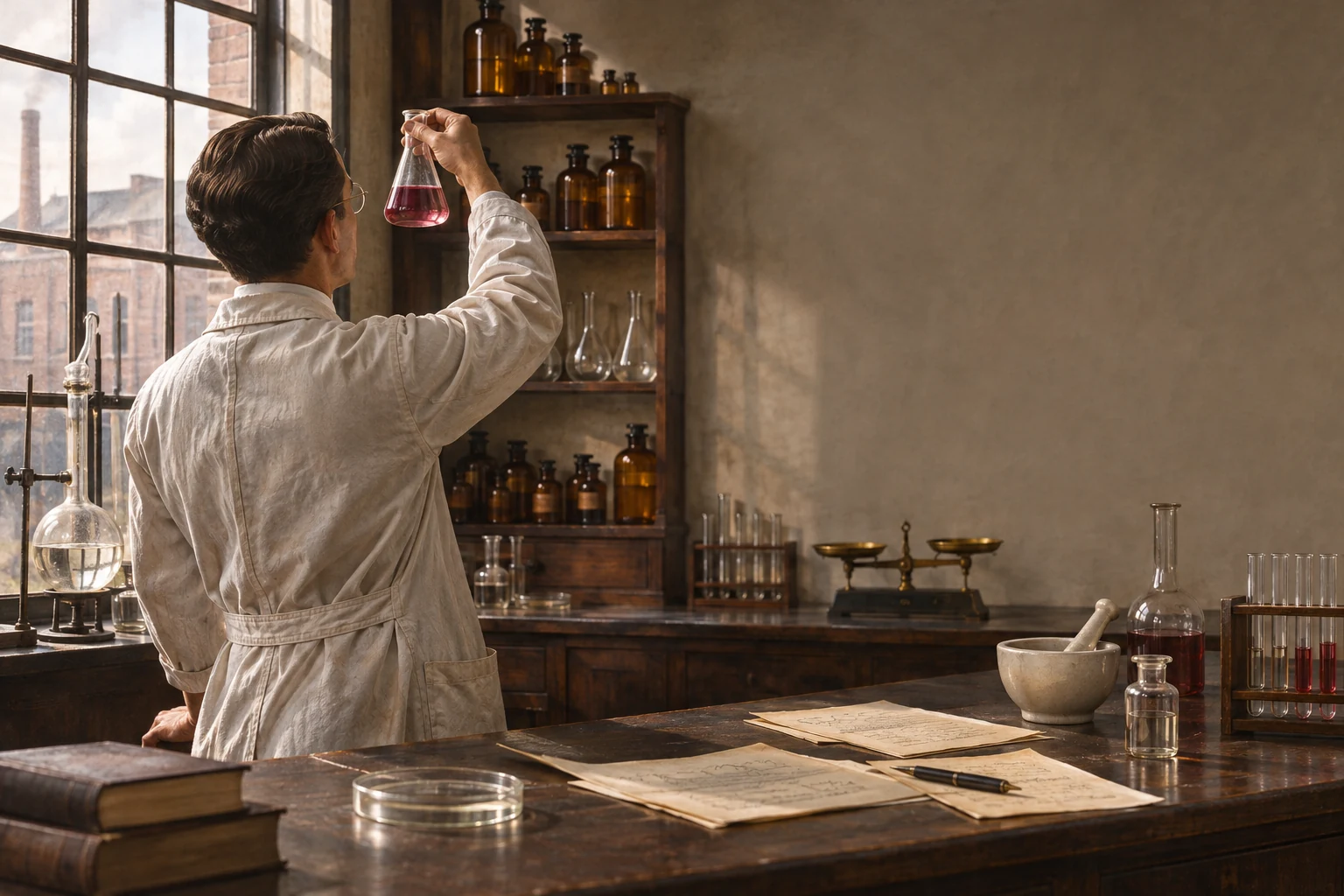
Follow Memento MedicaWritten and illustrated with AI assistance for Memento Medica. The lead image is a conceptual reconstruction, not an archival photograph, a likeness of Harold Watkins, or a documented Massengill laboratory. Factual claims were checked against the references listed below.
Sources & what we can know
This original account does not invent dialogue, victims, or Watkins’s private thoughts. Death totals are described as more than one hundred because official and scholarly tallies vary. Follow @MementoMedicaOfficial for more independently sourced stories from the history of medicine.
- FDA: Sulfanilamide Disaster
FDA historical account, read November 9, 2026. Used for formula, chronology, recall, deaths, Watkins, and legal aftermath.
- The Elixir Sulfanilamide Tragedy of 1937
Historical review and reproduction of the 1938 Secretary of Agriculture report, accessed November 9, 2026. Used for federal investigation and contemporary context.
- American Chemical Society: Elixir Sulfanilamide
ACS historical account, read November 9, 2026. Used for chemical and regulatory context.
- PubMed: Elixir Sulfanilamide Disaster
Peer-reviewed historical record, read November 9, 2026. Used for the poisoning mechanism and public-health significance.
- FDA: Milestones in U.S. Food and Drug Law
FDA chronology, read November 9, 2026. Used for the 1906 and 1938 legal framework.
- FDA: Part II—1938 Food, Drug, and Cosmetic Act
FDA legal history, read November 9, 2026. Used for the statute’s expanded powers and limits.