
Content note: Cancer, ineffective treatment claims, patient desperation, scientific fraud allegations, and early death; no graphic imagery.
The sample weighed one gram. The claim around it was immeasurable.
Krebiozen had been promoted as a treatment for cancer, defended by a prominent physician and embraced by patients who had few reasons to dismiss hope. Its composition remained obscure. When a sample finally reached the U.S. Food and Drug Administration, the question was narrower than the public argument: what was actually in the material?
In 1963, analytical chemist Alma LeVant Hayden led the FDA team that compared the sample’s infrared pattern with known chemicals. A summer student began moving through a library of roughly 20,000 reference chromatograms. The match appeared near the beginning of the alphabet.
The laboratory found creatine, a common compound with no demonstrated value as a cancer treatment. The result would be repeated by outside laboratories, disputed in court, and separated from its verdict in a way that still matters whenever science enters a courtroom.
Hope protected by a mystery
Krebiozen entered the United States around 1950 through Stevan and Marko Durovic, who described it as a substance derived from horse blood. Andrew C. Ivy, a respected physiologist with major scientific credentials, became its most important advocate. The endorsement gave the product authority before its composition or therapeutic value had been established through an agreed clinical test.
Cancer makes waiting feel dangerous. Patients and families were not responding to an abstract marketplace; they were confronting illness, limited treatment options, and the possibility that conventional medicine had overlooked something. By the early 1960s, thousands of people had reportedly received Krebiozen injections. Supporters organized, wrote letters, and treated access as a struggle between suffering patients and an inflexible establishment.
The product’s mystery helped it survive. Its promoters offered changing descriptions of what it was, while disagreement over testing conditions prevented the National Cancer Institute from conducting the kind of controlled evaluation it sought. Testimonial improvement could be interpreted as proof by believers, while deterioration could be attributed to late treatment or other disease.
That structure placed an unusual burden on chemical analysis. Before asking whether Krebiozen could treat cancer, investigators needed to know whether different ampules contained the same thing and whether the submitted substance matched the extraordinary story told about it.
The chemist before the case
Alma LeVant was born in South Carolina in 1927 and studied chemistry at South Carolina State College. At Howard University, she trained in analytical methods under chemist Lloyd Noel Ferguson and completed a master’s degree. Her early work demanded close attention to how compounds behave under chemical and optical tests.
She joined the National Institutes of Health in 1951, where photographs show her using paper chromatography to separate substances by the different distances they travel through porous paper. In 1956 she moved to the FDA. By the early 1960s she had published on infrared spectra and methods used to identify steroids, barbiturates, sulfonamides, and other compounds important to drug analysis.
In May 1963, Hayden became head of the Spectrophotometry Branch in the Division of Pharmaceutical Chemistry. She was a Black woman directing specialized federal laboratory work at a time when very few Black scientists, and still fewer Black women, held comparable positions in national science agencies.
Her significance cannot be reduced to being first or nearly first. The authority that mattered in the Krebiozen case came from technique: understanding what an infrared tracing could show, where it could mislead, and how to combine it with other methods until an identification became difficult to dismiss.
A pattern among twenty thousand
The FDA obtained an infrared spectrum from the National Cancer Institute and, after repeated requests, a one-gram sample supplied by Krebiozen’s promoter. Infrared spectrophotometry measures how a substance absorbs infrared light. Bonds within molecules absorb particular ranges, producing a pattern that can be compared with reference compounds.
Hayden’s team found that the tracing resembled an amino-acid-related substance present in the body. She assigned summer student Ruth Kessler to examine the branch’s library of roughly 20,000 chromatograms. The work was less cinematic than a single flash of recognition. It depended on an organized archive, comparable preparation, and patient elimination of alternatives.
Kessler found a match with creatine. Creatine participates in normal energy metabolism and is common in animal tissue. Identifying it in the submitted sample did not by itself reveal the full history of every Krebiozen ampule or every substance patients had received. It did destroy the idea that this one-gram sample contained an unknown, uniquely derived anticancer agent.
The result also showed why analytical infrastructure matters. A tracing is useful because someone has built standards, preserved them, and made comparison reproducible. Hayden’s discovery was not only a clever reading of a graph. It was the use of a public laboratory system designed to test private claims.
One method was not enough
A controversial result cannot safely rest on one instrument or one laboratory. FDA therefore arranged outside analyses using several techniques, including x-ray diffraction, mass spectrometry, microscopy, melting behavior, and different forms of chromatography.
Those studies identified the submitted material as creatine or creatinine, the closely related breakdown product. The National Cancer Institute also reviewed hundreds of patient histories and found no basis for concluding that the treatment controlled cancer. Chemical identity and clinical efficacy were different questions, but they pointed in the same direction: the public claims were unsupported.
The distinction remains important. Finding creatine did not prove that every person who reported improvement was dishonest or foolish. Cancer can change unpredictably; other treatments may be given at the same time; records can be incomplete; expectations can shape interpretation. Anecdotes can be sincere and still fail to establish that an injection caused an outcome.
Hayden’s team supplied something testimonials could not: a result other laboratories could challenge with the same physical material. The claim had moved from reputation and hope toward measurements that did not depend on who wanted the product to work.
The courtroom answers another question
Federal prosecutors charged Krebiozen’s promoters and associates with offenses that included false statements, violations of drug regulations, adulteration, and fraud. The trial began in 1965 and continued into early 1966. It involved 179 witnesses and a record extending to thousands of pages.
Hayden testified about the chemical identification. Laboratory evidence entered a setting governed by rules different from peer review. Jurors had to assess instruments, sampling, chains of custody, intent, regulatory language, and competing expert explanations while deciding whether prosecutors had proved specific criminal charges beyond a reasonable doubt.
The defendants were acquitted. That verdict was legally decisive for them, but it did not transform creatine into an anticancer drug or invalidate every independent analysis. An acquittal can mean that the prosecution failed to prove one or more elements of charged crimes. It is not a laboratory method and cannot establish efficacy.
The case therefore resists a simple ending in which science wins and error disappears. Support for Krebiozen survived the announcement of its composition. The courtroom outcome supplied new material for doubt. Evidence had become public, but public acceptance did not follow automatically.
What the sample could—and could not—settle
Hayden died of cancer in 1967, about a year after the trial ended. That fact can tempt a cruel narrative symmetry: the chemist who exposed a cancer remedy later dying from cancer. Her illness does not validate or refute the substance she tested, and it should not be used as irony.
Her work instead clarifies the scale of responsible claims. The submitted sample could be identified. External laboratories could corroborate that identity. Case histories could be reviewed for persuasive evidence. None of those steps promised patients that medicine already possessed a better answer.
Regulatory science often operates in that uncomfortable space. It may protect people by saying that a hopeful claim has not earned trust, even when it cannot offer a cure in exchange. The emotional force of need does not disappear when evidence is weak; it makes reliable evidence more necessary.
The one-gram sample did not contain a verdict about every person who believed in Krebiozen. It contained a chemical pattern. Alma Hayden’s achievement was to make that pattern answerable to other laboratories—and to insist that an extraordinary medical claim meet the ordinary discipline of identification.
More stories from Memento Medica
For more interesting content, follow Memento Medica on YouTube.
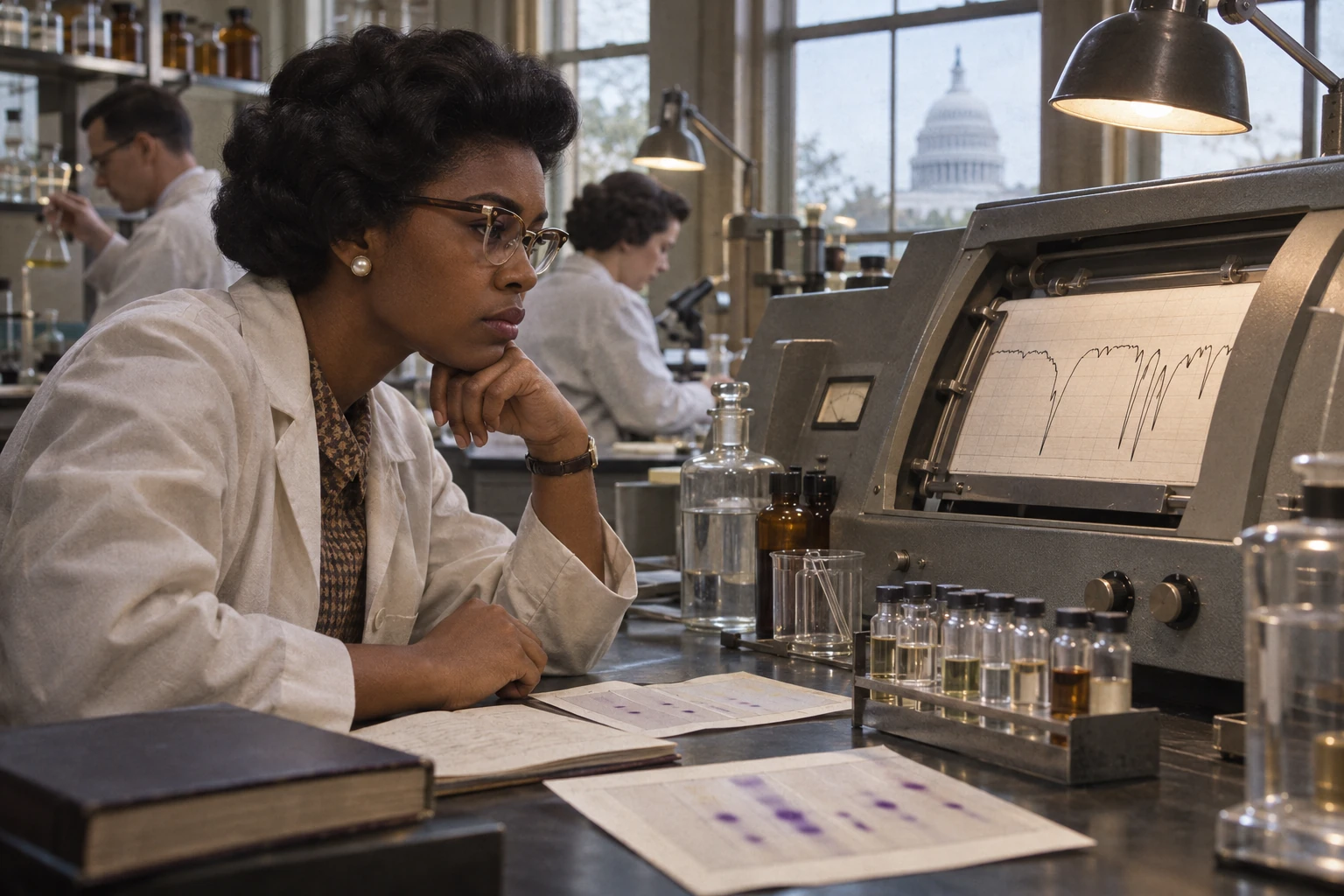
Follow Memento MedicaWritten and illustrated with AI assistance for Memento Medica. The lead image is a conceptual reconstruction, not an archival photograph, a likeness of Alma LeVant Hayden, or a documented Krebiozen analysis. Factual claims were checked against the references listed below.
Sources & what we can know
This original account does not invent patient stories, laboratory dialogue, Hayden’s private thoughts, or a claim that every Krebiozen ampule was chemically identical. It distinguishes the submitted sample, the broader clinical-evidence question, and the criminal verdict. Follow Memento Medica for more independently sourced stories from the history of medicine.
- FDA: Alma LeVant Hayden’s Contributions to Regulatory Science
FDA History Office exhibit, read November 2, 2026. Used for Hayden’s career, Krebiozen chronology, one-gram sample, analytical methods, outside corroboration, trial, and documented limits.
- NIH Intramural Research Program: Hidden Figures in Paper Chromatography
NIH historical profile, read November 2, 2026. Used for Hayden’s NIH work, paper chromatography, training, and laboratory context.
- American Chemical Society: Alma Levant Hayden
ACS historical profile, read November 2, 2026. Used for career chronology and the significance of Hayden’s federal scientific role.
- Oxford Academic: Nothing but Creatine
Scholarly book chapter abstract, read November 2, 2026. Used for the testing dispute, public controversy, and the FDA team’s finding.
- PubMed: The Krebiozen case—what happened in Chicago
Contemporary Science article record, read November 2, 2026. Used cautiously for the trial’s scale and historical context.
- Smithsonian National Museum of American History: Krebiozen Ampules
Museum object record, read November 2, 2026. Used to confirm surviving material culture and the distinction between the tested sample and the wider product history.