Content note: Lead poisoning, hazardous labor, worker illness and death, poverty, and weak workplace protection; no graphic imagery.
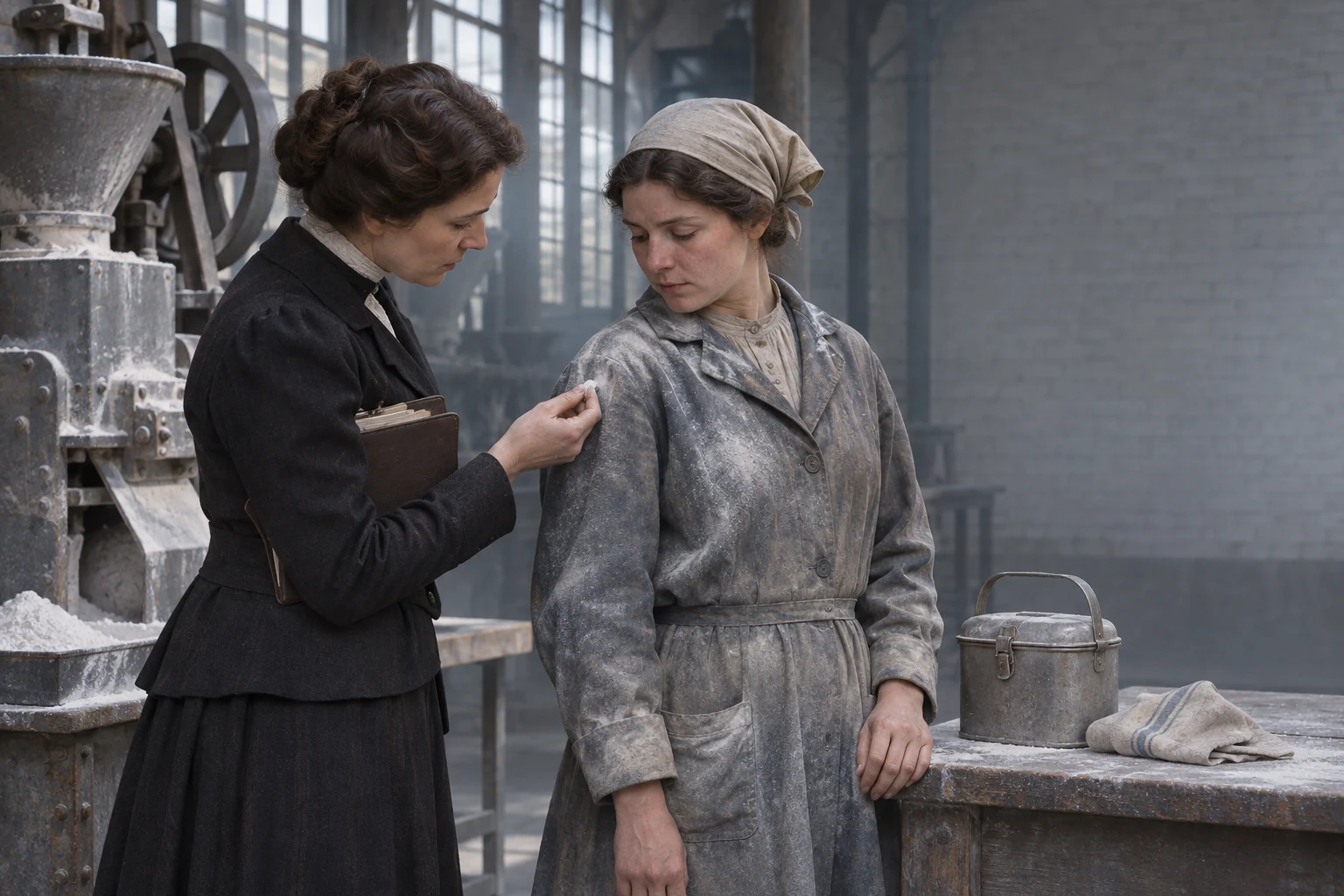
White dust clung to a worker’s coat beside the lunch tin. What if the illness was traveling with the job?
In 1909, Illinois created a commission to investigate occupational disease. Physician Alice Hamilton took on industries that used lead, a metal whose hazards were known but whose American workplace toll was poorly measured. She did not stay in a clinic and wait for cases to arrive.
Hamilton visited factories, questioned workers and doctors, read hospital and death records, and traced how dust and fumes moved through a workday. She found danger in mixing rooms, paint shops, enamel works, smelters, and other processes. The path of exposure ran through hands, clothes, food, breath, and the economic pressure to keep a job.
Her surveys helped establish occupational medicine in the United States, but they were not a solitary discovery. Workers, union organizers, local physicians, settlement-house colleagues, state investigators, and earlier European research all supplied knowledge. Hamilton’s achievement was to connect those sources until industrial illness became harder to dismiss as personal weakness.
From Hull House to the factory gate
Hamilton trained in medicine at the University of Michigan and in bacteriology in the United States and Europe. In 1897 she joined Hull House, the Chicago settlement where residents worked among immigrant and working-class neighborhoods. The address placed industrial illness close to domestic life.
Neighbors described injuries and sickness tied to dangerous jobs. A worker could leave a factory, but dust remained on clothing; lost wages could threaten a household; a diagnosis that required quitting might be medically sound and economically impossible.
Industrial medicine already had a substantial European literature. In the United States, enforcement and systematic investigation lagged. Employers often kept few useful health records, physicians might miss occupational causes, and workers moved between jobs. A case could disappear administratively even while the exposure continued.
Hamilton learned to treat absence as evidence requiring fieldwork. If a factory claimed no poisoning, she asked what records existed, where sick workers went, and whether former employees had simply vanished from the payroll.
The Illinois survey
The Illinois Commission on Occupational Diseases began work in 1909. Hamilton investigated lead trades, while other members examined additional hazards. The commission represented a shift from merely counting deaths toward studying the conditions that produced them.
Lead offered a difficult map. It appeared in white-lead pigment, paint, pottery glaze, enamel, printing, batteries, smelting, and many smaller processes. Exposure could produce abdominal pain, weakness, nerve damage, anemia, and other symptoms that did not always announce their source.
Hamilton entered workplaces, observed processes, and spoke with workers. She also searched hospital files, dispensary records, physicians’ notes, and death certificates. No single source was complete. Together they revealed cases that factory totals omitted.
The resulting evidence connected illness to particular tasks and conditions: dusty handling, poor ventilation, eating with contaminated hands, and clothes that carried lead away from the work area. The investigation made the workplace itself part of the medical history.
Why the lunch pail matters
A lunch container beside lead dust is not a decorative period detail. It marks a route between production and ingestion. Workers could swallow lead transferred from hands or airborne dust settling on food. They could inhale particles and fumes. Contaminated clothing could bring residues into homes.
Such routes challenged the idea that poisoning belonged only to unusually careless individuals. A person might follow the customs a workplace allowed and still face continuous exposure. Without washing facilities, separated eating areas, ventilation, or process control, personal caution had narrow power.
Hamilton’s reports repeatedly joined chemistry to organization. The toxic metal mattered, but so did how material was poured, ground, heated, swept, and carried; how fast people worked; whether symptoms cost them employment; and whether an employer recorded a case.
This wider frame gave occupational medicine its moral and scientific force. Disease was not simply located in a worker’s body. It emerged from a system of production whose design could be investigated and changed.
Evidence made from fragments
Hamilton’s methods were practical rather than perfectly standardized by modern epidemiologic rules. She followed leads, interviewed people, compared plants, reconstructed missing histories, and used clinical signs alongside workplace observation.
That approach could introduce selection and reporting limits. Surviving records favored severe or recognized cases; employers and workers had different reasons to disclose or conceal illness; diagnostic standards varied. Hamilton sometimes wrote with the reform language and assumptions of her era.
Yet the fragmented method answered a real evidentiary problem. When institutions did not count occupational disease, demanding a complete dataset before acting would preserve ignorance. Triangulation—finding the same pattern in workers’ accounts, medical records, and observed processes—made hidden harm visible.
Her reports often distinguished safer plants from dangerous ones within the same industry. That comparison weakened claims that poisoning was an unavoidable price of production. Different machinery, ventilation, housekeeping, hygiene, and medical oversight could alter risk.
Authority and its limits
Hamilton later conducted federal investigations of lead and other industrial poisons. Her work covered many trades and helped place occupational disease on the agenda of public health and labor regulation. In 1919, Harvard appointed her to its new Department of Industrial Medicine, making her the first woman on the university’s faculty.
That milestone came with restrictions: she was not granted all the privileges given male faculty. Institutional recognition did not erase the barriers surrounding it.
Nor should Hamilton’s prominence erase the people who made her investigations possible. Workers described symptoms and processes, local doctors opened records, settlement networks supplied trust, and reformers organized political pressure. European investigators had documented industrial poisons before her American surveys.
Her role was catalytic. She carried knowledge across factory floors, medical records, government reports, classrooms, and public arguments. The evidence gained authority because it could no longer be confined to one sick worker or one employer’s ledger.
A diagnosis workers could not afford
For a worker paid by the day or piece, recognizing an occupational cause could create a second danger. Leaving exposure might also mean losing wages, housing security, or the ability to support relatives. A clinical recommendation to stop work did not solve that conflict.
Hamilton’s field reports placed such pressures beside toxicology. They helped explain why cases could remain at a dangerous job, return after illness, or disappear from formal records. Economic constraint was not a competing story; it shaped the dose and duration that medicine was trying to understand.
Comparison as an argument for prevention
Factories using similar materials did not always produce the same illness pattern. Hamilton used those differences to ask which processes, controls, and routines separated safer plants from dangerous ones. Variation became evidence that disease was not an inevitable property of the worker or trade.
That comparison moved reform beyond warning individuals to be careful. If enclosed machinery, local exhaust, washing facilities, clean eating areas, and medical checks changed exposure, then prevention could be designed, inspected, and demanded.
The illness follows the process
The most durable idea in Hamilton’s work is a change of question. Instead of asking only what disease a person had, she asked what the person handled, breathed, wore, ate beside, and carried home.
That sequence made prevention imaginable. If illness followed a process, then changing the process could matter before the next diagnosis. Ventilation, enclosure, cleanliness, substitution, medical surveillance, and enforceable standards became subjects of evidence rather than favors.
Occupational medicine did not begin with one investigator, and its history did not end when lead poisoning became legible. Workers continued to face hazardous exposures, unequal enforcement, and conflicts between wages and health.
The white dust on a coat therefore remains more than a historical image. It is a record of how work crosses the boundary of the body—and of the investigative choice to follow it there.
More stories from Memento Medica
For more interesting content, follow Memento Medica on YouTube.
Follow Memento MedicaWritten and illustrated with AI assistance for Memento Medica. The lead image is a conceptual reconstruction, not an archival photograph, a likeness of Alice Hamilton, or a documented factory visit. Factual claims were checked against the references listed below.
Sources & what we can know
This original account does not invent workers, dialogue, or Hamilton’s private thoughts. It credits workers, physicians, commissions, settlement networks, and earlier research, and does not claim Hamilton alone founded occupational medicine. Follow @MementoMedicaOfficial for more independently sourced stories from the history of medicine.
- National Library of Medicine: Dr. Alice Hamilton
NLM biography, rechecked November 13, 2026. Used for training, occupational-health work, and Harvard appointment.
- CDC/NIOSH: Alice Hamilton and the Illinois Survey
NIOSH historical bulletin, rechecked November 13, 2026. Used for the 1909 commission, methods, and occupational-health context.
- Harvard T.H. Chan School: A Decades-Long Legacy of Protecting Workers’ Health
Harvard institutional history, rechecked November 13, 2026. Used for Hamilton’s 1919 faculty appointment and occupational-health legacy; appointment restrictions are independently supported by NLM and ACS.
- JAMA: Lead-Poisoning in Illinois
Hamilton’s 1911 article record, rechecked November 13, 2026. Used for the Illinois survey’s scope and contemporary framing.
- PubMed Central: Lead Poisoning in the United States
Digitized primary historical article, rechecked November 13, 2026. Used cautiously for methods, processes, and reported conditions.
- American Chemical Society: Alice Hamilton and the Development of Occupational Medicine
ACS National Historic Chemical Landmark history, rechecked November 13, 2026. Used for methods, lead trades, controls, federal work, and institutional context.